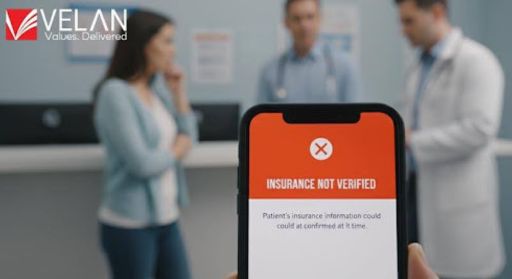
Accurate insurance verification is all the more critical in the complex healthcare environment we face today, and it is not merely an administrative step but rather one that acts as a critical line of defence for both patient satisfaction and financial stability. Healthcare companies take unnecessary risks without verifying insurance coverage like a pro. The repercussions can cascade through the entire organisation: denied claims, compliance concerns, and more.
In this blog, we will look at what can occur when confirmation of patient coverage is not obtained beforehand and why determining eligibility cannot be an afterthought for healthcare organisations but rather a key priority.
Understanding Insurance Eligibility Verification
Insurance eligibility verification is the procedure of making sure that the insurance policy of a patient is active and checking which services the policy covers. This includes verifying:
- Policy status (active or inactive)
- Covered benefits
- Co-pays, co-insurance, and deductibles
- Authorisation requirements
- Coverage limitations and exclusions
The moment you miss this step or do it wrong, many of the clinical insurance eligibility errors may occur and harm the providers as well as the patients.
1. Claims Rejected for Not Covered
If you skip verification, one of the immediate consequences can be claims denied for coverage reasons. However, if the patient’s policy is expired or if simply the policy does not provide the coverage for that particular service, the insurer declares the claim as rejected.
Inactive coverage is another common reason a claim is denied, which occurs when:
- A patient switching insurances recently
- Coverage expired
- Informed insurance, but incorrect insurance submitted
- That service is not covered by the policy.
Providers may provide services that the insurer will not pay for without confirming eligibility in advance. This leads to tedious rework and possibly lost revenue.
2. Eligibility-Related Claim Rejection
An eligibility-related claim rejection is different from a denial. Most denials happen mid-claim process, typically as a result of incorrect or incomplete information.
Common causes include:
- Mismatched patient details
- Incorrect policy numbers
- Missing group numbers
- Incorrect payer submission
Although rejections may be fixed and resubmitted, they add unnecessary costs to the administrative burden and postpone reimbursement.
3. Revenue Loss in Medical Practice
The most detrimental result, however, is practice revenue loss. Providers are often faced with challenges recovering payment when claims are denied or rejected for eligibility reasons.
And if the insurer ends up not paying and the patient cannot or does not want to pay out-of-pocket, the practice could have to write off the balance as bad debt.
This patient coverage verification failure can result in repeat appearances by the patient, leading to:
- Uncollected balances
- Increased write-offs
- Reduced cash flow
- Financial instability
Even small disruptions in revenue can create big problems in operations for small and mid-sized practices.
4. Increased Accounts Receivable Days
An increase in accounts receivable days represents how many days it takes for a practice to collect payments for provided services.
When claims are either broken or delayed:
- Employees have to check into what happened with the claim.
- Correct the issue
- Resubmit the claim.
- Follow up as necessary
Each one of those actions extends the time frame for reimbursement. A longer outstanding claim has an increased negative effect on the practice’s cash flow and operational effectiveness.
5. Front-End Billing Mistakes
Eligibility verification is a crucial part of the front-end billing process. When it is skipped, front-end billing mistakes become more common.
Examples include:
- Incorrect patient demographics
- Inaccurate insurance information
- Failure to identify prior authorisation requirements
- Wrong payer submission
These errors originate at the registration stage but impact the entire revenue cycle. Making adjustments to front-end errors will require more time and effort than avoiding them from the start.
6. Billing Errors in Healthcare
Well outside an enrolment issue, missed verification may cause larger-scale healthcare billing discrepancies. For example:
- Charging for non-covered services
- Incorrectly estimating patient responsibility
- Applying wrong co-pay amounts
- Miscalculating deductibles
Such errors cause medical billing errors in healthcare and create friction in the trust between patients and the providers. Unsurprisingly, nothing annoys patients more than receiving an unexpected bill, since nobody—and let me repeat that, nobody—likes surprises.
Describing job eligibility criteria clearly helps reduce confusion and introduces transparency.
7. Compliance Risks in Insurance Eligibility
The healthcare industry has a multitude of regulatory requirements. Providers fail to verify a patient’s insurance eligibility, and this creates compliance risks in insurance verification.
Providers are required to comply with all the guidelines and regulations provided by the payers. Submitting claims for services that are not covered or incorrectly coded may:
- Trigger audits
- Lead to penalties
- Result in fines
- Damage the organisation’s reputation
Accurate eligibility checks help ensure that billing practices align with payer rules and healthcare regulations.
8. Patient Unhappiness with Billing & Lack of Trust
Patients usually suffer when their eligibility isn’t confirmed, so if there is no payment from insurance, then there will be a large bill for the patient.
The result could be:
- Dissatisfaction & complaints
- Billing disputes
- Delays in collection
- Bad reviews
The patient wants to ensure that they’re getting the truth regarding what portion of the bill they’ll need to pay. So, patient coverage verification failure undermines that expectation, and when that happens, it deteriorates the patient-provider relationship.
9. Administrative Burden and Staff Burnout
Billing teams have to do beast work due to insurance eligibility errors. Staff must:
- Investigate denials
- Contact payers
- Call patients
- Correct documentation
- Resubmit claims
Making the same mistakes consumes time and energy and does not help productivity. This leads to staff burnout and low morale over time.
Staff fix avoidable errors when they could be improving the strategy.
10. Risk of Bad Debt
If coverage is deactivated and the affected patient cannot pay, the remaining cost may enter into bad debt. Such an incident can lead to a claim denial due to inactive coverage, which typically means a provider will go after patient collections.
However, a patient could dispute the charge if he or she believes that the insurance was active at the time. It leads to collection difficulties and can damage the practice’s reputation.
Regular eligibility verification can reveal financial responsibility prior to rendering services, providing an opportunity to initiate the conversation about payment.
11. Disrupted Revenue Cycle Management
Revenue cycle stages: Insurance verification is the first step. If you skip it, the entire cycle is compromised.
Consequences include:
- More claim rework
- Higher denial rates
- Delayed reimbursements
- Poor financial forecasting
- Increased operational costs
So, a high-performing revenue cycle starts with credible data. Downstream processes become unstable when there are no checks in place.
12. Legal and Contractual Risks
Many insurance contracts require providers to confirm eligibility and benefits prior to billing. Payers can end up in contractual disputes with providers who fail to comply.
If a practice receives a large number of eligibility-related claim rejections, its practice may be flagged for a review. The outcome may include:
- Increased scrutiny
- More difficult contract renegotiations
- Potential loss of network
Properly maintaining verification procedures will help protect your organisation from avoidable exposure to the law.
Why Is Verifying Insurance Coverage So Important?
To stop denying patients for lack of health insurance coverage prior to their appointment, healthcare organisations can take the following actions:
- Verify insurance 24–72 hours prior to the patient’s appointment.
- saaaaUtilise automated tools when possible to verify the patient’s insurance eligibility.
- Thoroughly train the front desk employees on how to complete this process.
- Double-check the demographic information for each patient.
- Confirm whether the patient’s authorisation has been completed.
Verifying insurance proactively helps reduce billing errors in healthcare and ultimately increases revenue for healthcare organisations.
Conclusion
Insurance eligibility verification is critical for many reasons, as it prevents numerous problems for healthcare providers. Insurance eligibility errors can lead to denied claims due to coverage issues, eligibility-related claim rejection, and even a claim denial due to inactive coverage. These issues are often the reason for healthcare billing mistakes, front-end billing errors and a patient coverage verification failure.
As a result, practices may experience revenue loss in medical practice, an increase in accounts receivable days, and higher compliance risks in insurance verification.