If you’ve ever checked your home’s value online, chances are you’ve looked at Zillow.
For a lot of homeowners, that number becomes the reference point. It feels official. It’s easy to access. And in many cases, it’s the first thing people see when they start thinking about selling.
But here’s the reality most people don’t realize:
That number is only one version of your property’s value — and it’s often not the one that actually matters when it comes time to make a decision.
The Problem With a Single Number
Zillow’s Zestimate is designed to give a general idea of value based on public data and comparable sales. It works well as a rough estimate, especially in areas where homes are very similar.
But real properties aren’t always that simple.
Two homes on the same street can have completely different values depending on things that algorithms don’t fully capture, like:
Factors Algorithms Often Miss
- Interior condition
- Renovation quality
- Deferred maintenance
- Unique layouts or additions
- Timing and market demand
A house that needs significant repairs can show a Zestimate close to a fully renovated home nearby — even though the real-world value difference could be tens of thousands of dollars.
That’s where the disconnect starts.
What Investors Look At Differently
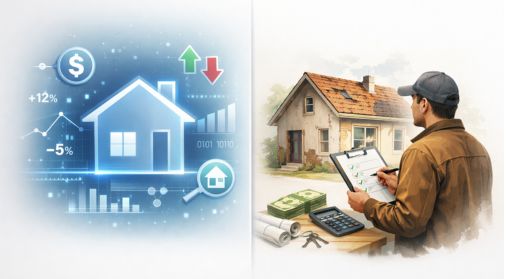
When a real estate investor evaluates a property, they’re not looking at a single number.
They’re breaking it down into multiple layers of value.
Key Investor Evaluation Metrics
- As-Is Value – What the property is worth in its current condition
- Renovated Value (ARV) – What it could sell for after improvements
- Repair Costs – What it takes to get from the current condition to market-ready
- Margin & Risk – The buffer needed to make the deal make sense
So while a Zestimate might say your home is worth $300,000, an investor could look at the same property and arrive at a very different number based on what it actually needs.
That doesn’t mean one is “right” and the other is “wrong” — they’re just looking at value from completely different perspectives.
Why This Matters for Homeowners
This is where a lot of confusion happens.
As someone who works directly with homeowners and investors, a homeowner sees a Zestimate and expects offers to match that number.
Then when real offers come in lower, it feels like something is off.
But in reality, it’s just a different lens being applied.
Different Buyer Perspectives
- A retail buyer may pay close to market value for a move-in-ready home
- An investor is factoring in repairs, time, and risk
- The market itself can shift depending on timing and demand
Your property doesn’t have one fixed value — it has multiple, depending on how it’s being viewed.
The Bigger Picture
Understanding this can completely change how you approach selling.
Instead of asking:
“What is my home worth?”
The better question becomes:
“What are my options, and what does my property look like through each one?”
Because the best decision isn’t always about the highest number — it’s about the scenario that fits your situation.
A Smarter Way to Look at Value
This is exactly where newer tools are starting to shift the conversation.
Instead of relying on a single estimate, platforms are beginning to break down properties into multiple value points — giving homeowners a clearer picture of what their property could look like across different paths.
What Modern Tools Help You Understand
Tools like Topular AI, for example, focus on helping owners understand:
- What their property might sell for as-is
- What an investor might offer
- What it could be worth after improvements
If you want to see how this works in practice, you can try Topular AI – Topular Home Solutions, a platform designed to break down your property’s real value
Final Thoughts
Zillow made it easy to access home values.
But simplicity can sometimes create misunderstanding.
The reality is, your property’s value isn’t one number — it’s a range shaped by condition, timing, and strategy.
And once you understand that, you’re in a much better position to make the right move.