The first thing to understand about vehicle transport is that you are not buying a shipment. You are posting a job into a spot market and waiting for an independent operator to decide it is worth taking. Every procurement instinct that works for parcel freight — fixed rate cards, guaranteed delivery dates, a single vendor accountable end to end — runs into that reality within about a week of trying it.
This matters more than it sounds, because it explains the two complaints that come up in every post mortem on a bad vehicle move. The rate that was quoted is not the rate that moved the car. And nobody can tell you exactly when it will arrive. Both are features of how the market is built, not failures of the company you hired.
A Quote Is a Bid, Not a Price
The assumption going in is that a quote behaves like any other vendor quote. You accept it, it becomes the price, the service happens.
But vehicle transport runs on load boards. Your vehicle gets posted with a dollar figure attached, and thousands of owner operators — most of them running one to five trucks — scroll those boards looking for freight that fits the route they are already driving. If your number is competitive for that lane on that day, a driver claims it within hours. If it is low, your vehicle sits there while better paying loads move ahead of it.
So a low quote does not buy you a cheap move. It buys you a slow one, or a call three days later explaining that the rate needs to go up to get the vehicle covered. Procurement teams that award on lowest bid and then measure vendors on cycle time are, without realizing it, penalizing the vendor for the thing they themselves chose.
The practical version: treat quotes the way you would treat a market price rather than a fixed one. Ask what rate will actually get the vehicle covered on that lane this week. A vendor who answers that question honestly is more useful than one who tells you what you want to hear and renegotiates later.
You Are Contracting With Two Companies, Not One
Most buyers believe they have hired a trucking company. They have usually hired a broker.
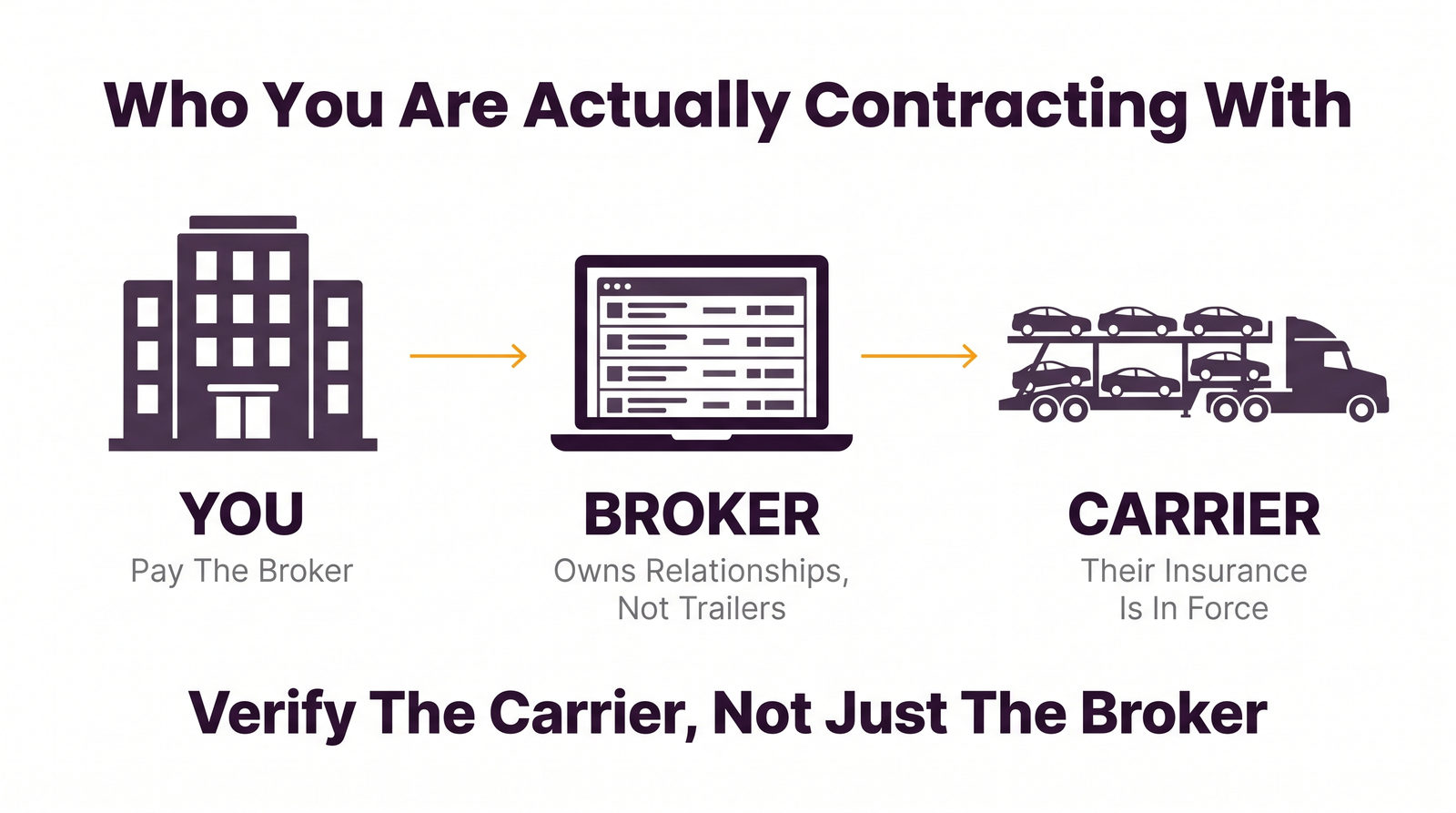
Brokers dont own trailers. What they own is carrier relationships and access to the boards, and they arrange the move with an independent carrier who actually hauls it. That isnt a problem — it is how nearly the entire industry works, and a good broker is genuinely valuable because they know which carriers handle which equipment properly. But it changes where your risk sits, and that is worth getting right in writing.
The carrier is the party whose insurance is in force when the vehicle is on the truck. Not the broker’s. So the diligence question is not just “is this broker reputable” but “who is the carrier, and are they covered.” Every legitimate interstate carrier holds operating authority and a USDOT number, and you can run that number through a free federal carrier lookup to confirm the authority is active and see the safety record. It costs nothing and takes two minutes.
Ask three things before you sign anything: who the carrier is, what their cargo insurance limit is, and whether the deductible applies per vehicle or per load. Cargo limits commonly sit between $100,000 and $250,000 per load — which is a different proposition when there are nine vehicles on that trailer sharing it than when there is one.
The Delivery Address Is a Constraint, Not a Detail
Nobody thinks about site access until a truck is sitting somewhere it can’t leave.
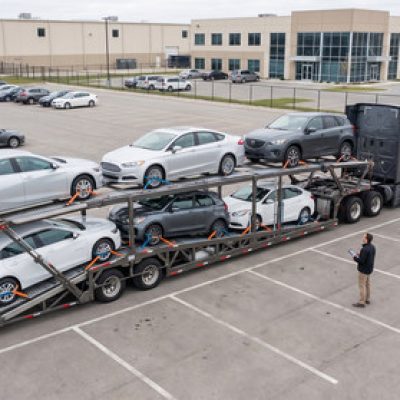
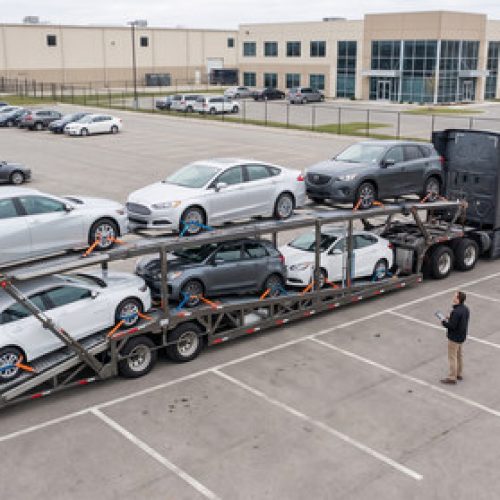
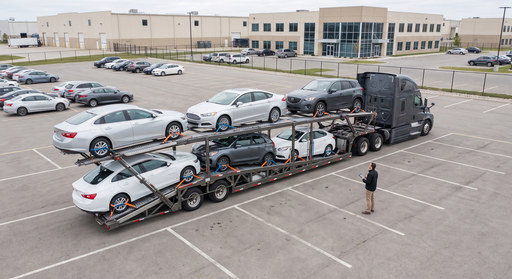
A loaded car hauler runs 75 to 80 feet and needs room to turn, room to drop the ramps and clearance overhead. Branch yards ringed with parked inventory, industrial parks with tight corners, sites with one gate and a security desk that closes at five — each of those decides whether the truck can physically deliver where your address says it should.
Door to door auto transport means as close to the site as the equipment can safely and legally get, which on a constrained yard may be a staging lot nearby. That is normal and every experienced driver handles it by calling ahead. The failure mode is not the truck. It is nobody on site being briefed that it might happen.
The more expensive version of the same problem is the receiving end of the paperwork. Somebody has to be present to walk the vehicle, note damage on the bill of lading and sign for it. If the truck arrives at six and your site closed at four, either the driver waits — and waiting costs money — or somebody signs a clean bill of lading for a vehicle they never properly inspected. That second option is how transport damage quietly becomes your problem instead of the carrier’s. Naming a specific person and a realistic delivery window at booking prevents more claims disputes than any amount of arguing afterward.
What Actually Moves the Price
Distance is the obvious input.. and the least interesting one.
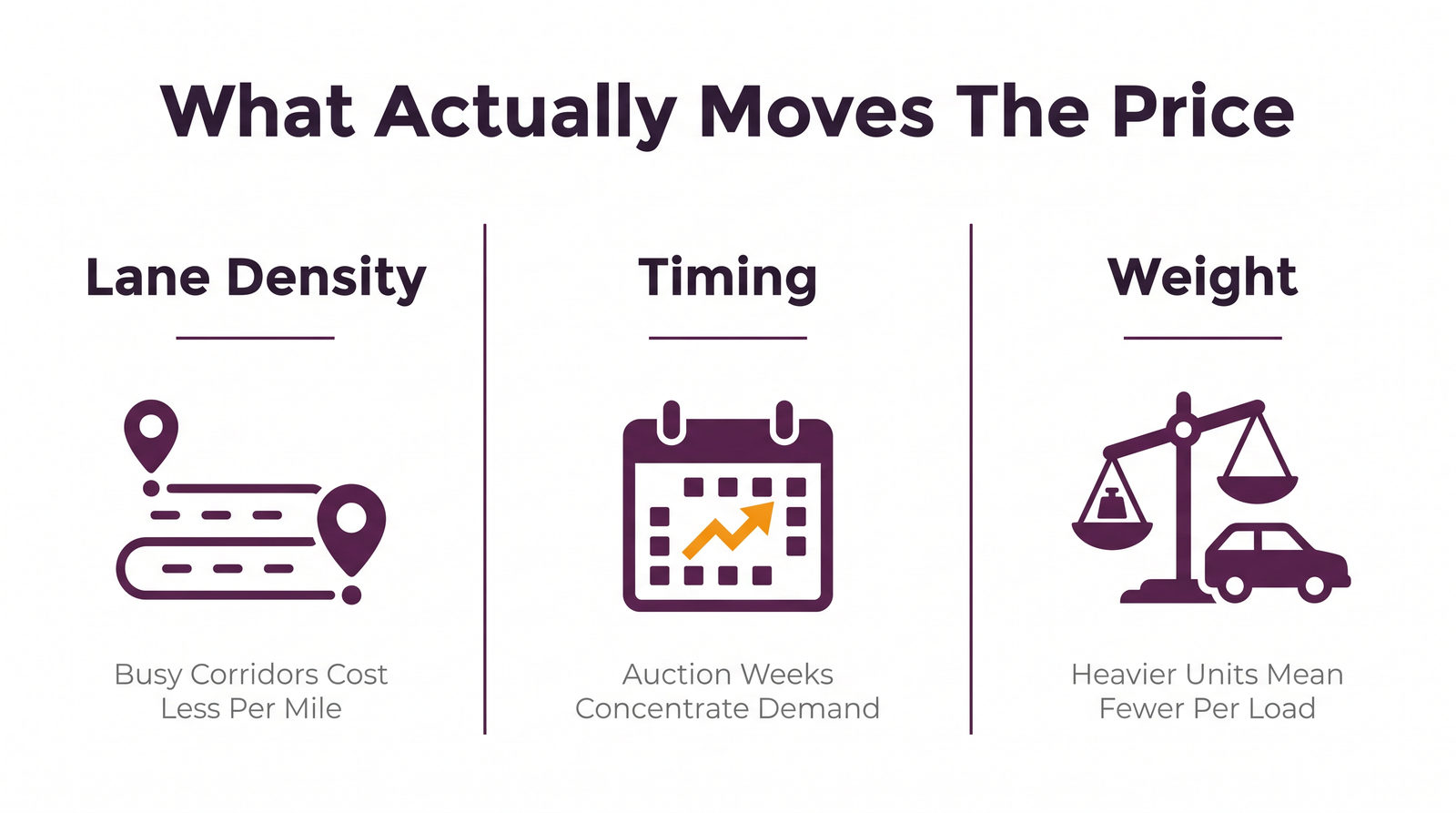
Lane density matters more. Dense corridors are cheap per mile because trucks run them constantly and a driver can fill a trailer in a day. Thin lanes into rural areas cost more, because somebody has to drive empty to reach you, and empty miles are the most expensive miles in trucking. The rate per mile also falls as distance rises — short moves under 500 miles run high per mile because the truck still has to be dispatched, loaded and unloaded regardless.
Timing is the second lever, and it is the one businesses control best. Auction calendars and seasonal migrations concentrate demand into narrow windows, and rates in those windows reflect it. Consolidating into fewer, fuller loads on a quieter week beats moving vehicles piecemeal against a deadline.
Weight is the lever nobody sees coming. A trailer runs out of legal weight before it runs out of space — a loaded rig is capped at 80,000 pounds gross on the interstate system, and tractor plus trailer accounts for 32,000 to 38,000 of that before a single vehicle rolls on. Ten ordinary sedans fit inside what remains. Ten electric crossovers at 5,000 pounds apiece do not, so the driver takes seven or eight, and his fixed costs get divided across fewer units. That is why electrified inventory costs more to move on the same lane. It isnt a surcharge somebody invented.. it is division.
Transit Time Is a Working Capital Cost
Here is the part that rarely makes it into the transport conversation, because transport usually reports to operations and working capital reports to finance.
Every day a vehicle is in transit or waiting for a truck is a day of capital tied up in an asset that is earning nothing and depreciating slightly. On a single unit that is noise. Across a few hundred movements a year it is a real number, and it is the number that should decide how much flexibility you buy.
Which reframes the cheap quote. Saving $150 on a rate and then waiting nine extra days for the vehicle to be covered is not a saving on anything except the line item it appears on. The relevant comparison is rate plus carrying cost plus the operational cost of the vehicle not being where it is needed. Buyers who run that arithmetic tend to stop optimizing purely on rate fairly quickly.
When Not to Outsource It at All
Not every movement should go on a truck, and a vendor who tells you otherwise is selling rather than advising.
Under roughly 500 miles, a driveaway usually wins on both cost and speed for single units — no waiting for a load to fill, no minimum, and the vehicle arrives when the driver arrives. For anything tall, heavy or awkward enough to need a scarce lower deck position, driveaway sidesteps the constraint entirely. And for anything with a fixed in service date attached, the certainty is often worth the premium.
The tradeoff is mileage and wear on the asset, which matters far more on a unit you intend to run for years than on one heading to auction next month. The honest rule is that hauling wins on volume and distance, driveaway wins on urgency and awkwardness, and organizations that use one method for everything are overpaying on roughly half their movements.
Before you next request quotes, ask whoever owns this internally what your average dwell time is between booking and pickup. Most organizations don’t track it, and it is usually the most expensive number nobody is measuring.