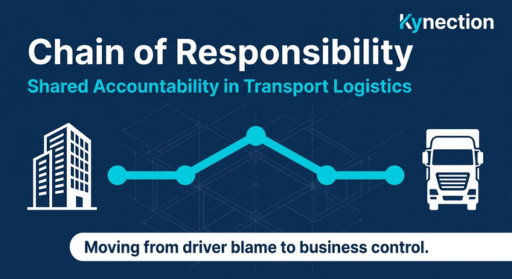
Transport compliance is often considered a driver issue. In reality, accountability is shared throughout the supply chain. Chain of Responsibility (CoR) is part of the Heavy Vehicle National Law and applies to the people whose decisions shape the transport task. That includes businesses that schedule work, prepare loads, manage dispatch and control the flow of information. The challenge with chain of responsibility transport is not just knowing the rules, but showing how those rules are applied in practice.
That is why CoR matters beyond the transport team. The law makes clear that safety duties are shared by parties in the chain and depend on the function a person or business performs, not simply their title. In plain terms, if your work influences a heavy vehicle journey, your decisions may carry compliance risk.
Why This Matters More Now
In many businesses, CoR is still treated more as paperwork than as something built into transport planning. On its own, that approach creates too many gaps in the process.
CoR is built on influence and control. Risk can begin with a rushed delivery promise, late loading, poor route planning, weak maintenance follow-up or missing transport information. By the time the truck is underway, that pressure may already be part of the job. Parties in the chain are expected to ensure, so far as is reasonably practicable, the safety of their transport activities and must not directly or indirectly cause unsafe conduct that leads to fatigue, speed, mass, dimension or loading breaches.
This is why CoR is better understood as a business control issue. It covers operations, dispatch, warehousing, transport planning, contractor management and leadership oversight. It is not only about whether a driver did the right thing, but also about whether the business created the conditions for safe and lawful work.
Where Compliance Pressure Builds
Most CoR issues are not caused by one major failure. They usually come from small disconnects in the way teams, systems and daily routines operate.
Common pressure points include:
- delivery schedules that leave no room for lawful work and rest
- incomplete load or consignment information
- poor visibility over maintenance or vehicle readiness
- contractor instructions handled through disorganised emails or calls
- safety records stored in different places and hard to check
- managers seeing reports after the problem, not while it is developing
These gaps matter because CoR focuses on what a business can influence and control. If your systems do not show who approved a task, what information was available at the time and what action was taken once a risk appeared, it becomes harder to justify that the business took reasonably practicable steps.
Why Leadership Has A Role Here
The NHVR states that executives of businesses in the Chain of Responsibility have a due diligence duty. This means they must take reasonable steps to understand transport risks, ensure that the right resources and processes are in place, and see that issues are identified and addressed in time.
That raises the standard for leadership oversight. It is no longer enough to assume compliance is being managed on the ground. More than policies on paper, leaders need clear visibility into how controls are working in regular operations. The real question here is whether the business can show how those policies are reflected in the way work is planned, approved and carried out. This is not a governance formality but a practical question of whether leaders can see what is happening before something goes wrong.
What Compliance Looks Like in Practice
Strong CoR compliance comes down to whether the business can show control over the transport task.
First, decision-making is clearly assigned. The business knows who is responsible for scheduling, loading, route planning, maintenance and records.
Second, records are complete and easy to trace. Missing, delayed or inconsistent documents make compliance harder to prove.
Third, related processes are connected. Scheduling, fatigue, maintenance, incident records and compliance forms should align when they involve the same transport task.
At its core, practical compliance depends on defined ownership, reliable records and processes that promote safe and lawful work.
Why Records Count in CoR
Good records are not only useful at audit time. They also help businesses identify issues earlier, show what action was taken when conditions changed and reduce confusion when a job shifts during the day.
That is especially important in transport because work rarely stays fixed. Delivery times move, loads shift, vehicles need maintenance and instructions can be updated at short notice. Without clear records, it becomes harder to see what changed and how the business responded. Audit readiness also becomes important here. When records are time-stamped, traceable and retrievable, businesses are in a stronger position to show that their safety systems are being actively managed.
That is where system design matters, not just whether records exist, but whether they are accessible to the right people at the right time. It is also one reason more compliance processes are shifting towards digital systems. Paper records still have a place, but they are more difficult to manage once work starts moving. Digital systems make it easier to keep fatigue records, maintenance history, incident reports and other compliance documents in one place. That does not mean software creates compliance on its own, but it does make a sound process simpler to manage and prove.
A Practical Way To View CoR
A useful way to view Chain of Responsibility is this: it is a test of whether the business can control transport risk at the points where that risk is created.
That includes:
- what was promised to the customer
- how the job was scheduled
- whether the load was ready and accurate
- whether the vehicle and driver were fit for the task
- whether records were completed and checked
- whether emerging issues were seen and acted on
Each of these points is where a business either demonstrates control or exposes a gap.When businesses look at CoR this way, it stops being a narrow compliance task and becomes part of better operations. It strengthens visibility, accountability and consistency. It also helps prevent the smaller process failures that later become larger legal and safety problems.
Conclusion:
Chain of Responsibility in transport is shaped by the decisions that guide the job from start to finish. It is present in scheduling, loading, maintenance, record-keeping and the way issues are resolved when plans shift.
Businesses that manage CoR well have clear responsibilities, reliable records and processes that hold up under pressure. Strong compliance is not a last-minute response. It comes from a system that supports safe and lawful transport work every day.