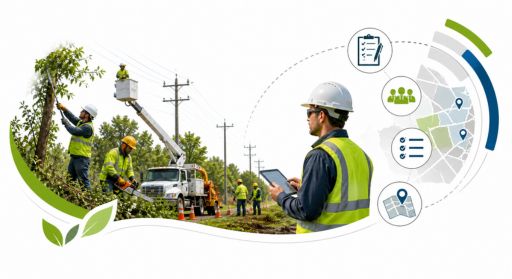
Running a vegetation management business looks straightforward from the road. A truck, a chipper, a crew with chainsaws, and a stretch of right-of-way to clear.
In reality, the contractors who make real money in this trade know the work is closer to logistics than landscaping.
You’re managing crews working at height around energized lines, juggling utility contracts with strict performance metrics, and carrying liability that can exceed the value of a contract on a single bad day.
This guide breaks down what it actually takes to run a successful vegetation management services business—from contracts and crews to the insurance coverage that keeps your company protected.
What Does a Vegetation Management Services Business Cover?
Vegetation management is not a one-size-fits-all service. The most successful contractors typically specialize in one or two areas before expanding.
Core Service Categories
1. Utility Line Clearance
Tree pruning and removal along transmission and distribution lines. This is the backbone of most vegetation management businesses.
2. Right-of-Way Clearing and Maintenance
Ongoing vegetation control across utility corridors, pipelines, railroads, and highways—often structured as multi-year contracts.
3. Integrated Vegetation Management (IVM)
A strategic mix of mechanical clearing, herbicide application, and selective planting to control long-term growth.
4. Storm Response and Emergency Restoration
Rapid deployment after extreme weather events to clear debris and restore essential services.
5. Hazard Tree Assessment and Removal
Identifying and removing trees that pose immediate or future risks to infrastructure or property.
Vegetation-related interference is one of the leading causes of power outages, which means utility clients closely monitor performance. Falling short on reliability metrics can cost you contract renewals—regardless of field performance.
What Should Your Contracts Look Like?
Vegetation management contracts—especially with utilities—are complex and highly detailed. They go far beyond basic service agreements.
Key Elements of a Strong Contract
1) Defined Scope and Territory
Clear assignments based on circuits, spans, or right-of-way sections.
2) Compliance Requirements
Includes standards such as vegetation clearance regulations for transmission lines.
3) Performance Metrics
Measured through outage rates, completion targets, and quality audits.
4) Insurance Requirements
Minimum coverage limits, additional insured clauses, and waivers of subrogation are standard.
5) Indemnification Clauses
Often favor the utility heavily—these must be reviewed carefully before signing.
6) Bonding Requirements
Performance and payment bonds are common for large contracts.
7) Pricing Models
Can be unit-based, hourly, or hybrid depending on project scope.
A well-structured contractor program supports your ability to meet these obligations. Bundled insurance solutions tailored for vegetation management are far more effective than piecing together policies from general providers.
Important: Always have legal counsel review contract terms—especially indemnification clauses. Some risks cannot be fully transferred or insured.
How Do You Build and Manage the Right Crew?
Crew quality is the single most critical factor in this business. The work is high-risk, highly skilled, and labor-intensive.
Typical Crew Structure
(1) Foreman (LCQA Certified)
Leads the crew and ensures compliance for energized line work.
(2) Climbers and Aerial Lift Operators
Handle elevated work using bucket trucks and cranes.
(3) Ground Crew
Support operations with debris handling, traffic control, and equipment setup.
(4) Equipment Operators
Run specialized machinery like mulchers, skid steers, and mowers.
(5) Certified Arborists
Provide expert assessments, prescriptions, and quality checks.
Training and Certifications
To stay compliant and competitive, crews need ongoing training in:
- Electrical safety standards
- First aid and CPR
- Aerial rescue procedures
- Herbicide application (for IVM services)
- Third-party safety verification systems
Retention and Workforce Stability
Labor shortages are a real challenge in this industry. Skilled workers—especially those qualified for energized line work—are in high demand.
To retain talent:
- Offer competitive wages
- Build clear career progression paths
- Invest in continuous training
- Prioritize safety culture
A stable, experienced crew is often the difference between winning and keeping contracts.
What Insurance Coverages Do You Actually Need?
Vegetation management carries a unique and high-risk exposure profile. Your insurance program must be comprehensive and tailored.
Essential Coverage Types
1. General Liability
Typically requires high limits due to the scale of risk—often $5 million or more.
2. Commercial Auto
Covers trucks, trailers, and specialized vehicles, including hired and non-owned vehicles.
3. Workers’ Compensation
Critical due to the hazardous nature of the work, especially near power lines.
4. Inland Marine
Protects mobile equipment such as chippers, saws, and lifts.
5. Wildfire Liability
A crucial coverage for contractors working in fire-prone areas, often requiring high limits.
6. Pollution Liability
Necessary for herbicide use and environmental exposure.
7. Umbrella/Excess Liability
Provides additional protection against catastrophic claims.
Why Wildfire Coverage Is Critical
Wildfire risk is one of the most underestimated exposures in vegetation management.
A missed hazard tree today can result in a wildfire claim years later—potentially costing millions. Many standard policies limit or exclude wildfire-related damages, making specialized coverage essential.
Conclusion:
Running a vegetation management services business is far more complex than it appears. Success in this industry requires a balance of operational efficiency, skilled workforce management, and robust risk mitigation.
From navigating detailed utility contracts to maintaining highly trained crews and securing comprehensive insurance coverage, every aspect of the business plays a critical role in long-term sustainability.
Contractors who treat vegetation management as a disciplined, systems-driven operation—not just fieldwork—are the ones who scale successfully. By focusing on specialization, investing in people, and protecting your business with the right coverage, you position yourself to compete for—and retain—the most valuable contracts in the industry.