Anyone who has stood at a conference pickup point, watching guests check their phones and squint down an empty road, knows the feeling. There is always an ambiguity in the arrival of the shuttle. Event transportation is a major part of any event because multiple things can cause an issue with such large numbers of attendees. Multiple vehicles, drivers, pickup points, and tightening time windows all need to move in sync. Spreadsheets and phone chains tend to buckle once the numbers grow. Transportation scheduling software offers a steadier way by planning, dispatching, and monitoring vehicles from a single dashboard. This blog explains how it works, the advantages for fleet managers and planners, and what to weigh before choosing your platform.
Common Event Transportation Challenges
Before looking at what the software does, it helps to name what tends to go wrong without it. These issues repeat across event types, regardless of budget or scale.
- Late arrivals that push back sessions, ceremonies, or entire schedules
- Missed pickups when a driver and a guest simply miss each other
- Driver confusion over routes, gate changes, or last-minute instructions
- VIP transportation requests that get lost in a general dispatch queue
- Parking congestion at venues never built for event-level traffic
These aren’t rare mishaps. They’re the default outcome once guest transportation grows past what a phone tree or spreadsheet can track.
What Is Transportation Scheduling Software?
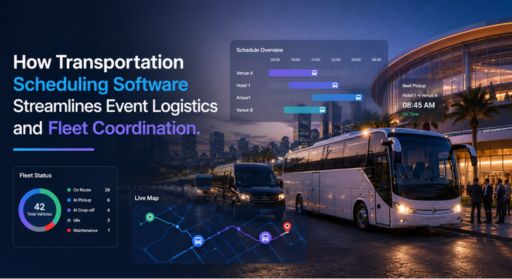
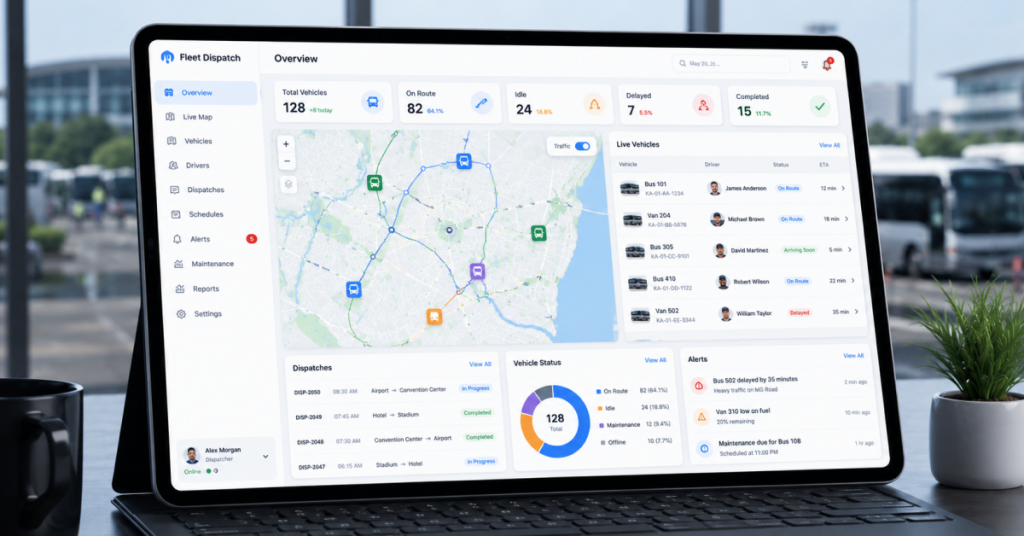
At its core, this is a platform that plans, assigns, and tracks vehicles, drivers, and routes from a single dashboard, rather than five disconnected ones. Industry research draws a useful line between two approaches. Scheduling tools generate optimal routes, but a dispatcher still has to act on them manually. Execution led platforms go a step further. They connect planning directly to what’s happening on the road, reoptimizing routes mid-run without anyone lifting a phone.
Most platforms share a similar backbone: a route planning engine, driver and vehicle assignment logic, live GPS tracking, and some kind of communication layer for riders or guests. It is a clear improvement on spreadsheets, but it doesn’t share real-time details.
The interesting aspect of this category is how it handles both. The same underlying engine handles a one-time event surge and the grind of everyday fleet coordination, just tuned differently for each. A well-built scheduling platform should flex between both without asking a fleet manager to learn two separate systems. Many of today’s event transportation systems are simply this same core engine, wrapped in features for guests that a routine delivery fleet would never need.
Why Modern Events Need Transportation Scheduling Software
Picture a corporate offsite with four pickup points, four hotels, and a keynote starting in ninety minutes. Guests trickle out on their own schedules, not a spreadsheet’s. VIPs need priority seating. And somewhere, a driver is stuck behind a delivery truck nobody accounted for.
That’s the exact problem event transportation solutions exist to solve. When manual coordination handles fifty or so vehicle movements, it holds up reasonably well. Push that past a few hundred, spread across multiple venues, and things start slipping through the cracks. We’ve seen this play out at weddings, marathons, festivals, and corporate offsites alike. The event type changes. The breakdown pattern, oddly enough, rarely does. This is where dedicated event shuttle software tends to earn its keep.
Common Event Day Breakdowns
- Double-booked vehicles or drivers, discovered only once, both show up
- Zero visibility into where a shuttle actually is, for guests or for planners
- Slow communication when a route needs to change on short notice
- Manual dispatch mistakes during the crush of peak arrival or departure
How Transportation Scheduling Software Simplifies Event Transportation
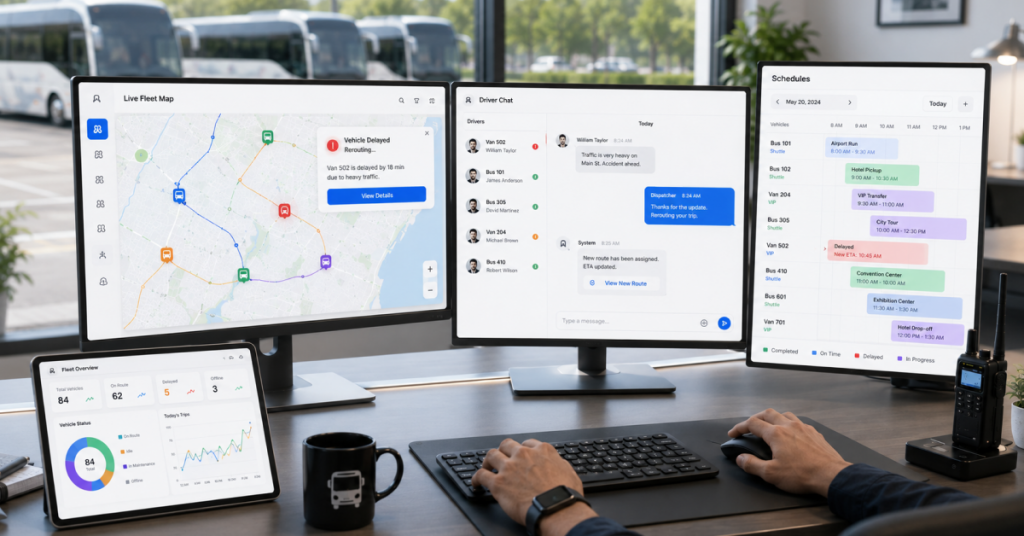
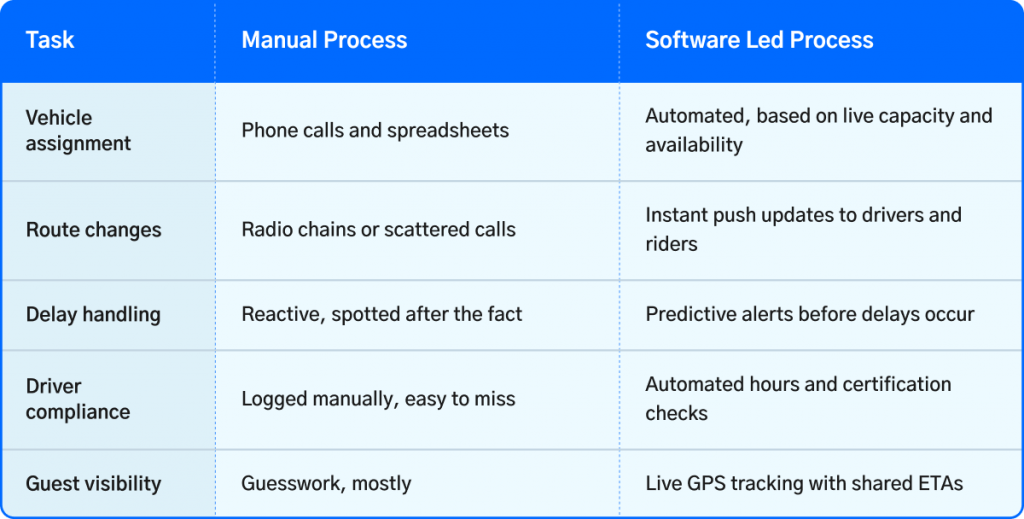
Good transportation scheduling software centralizes vehicle capacity, driver assignment, compliance windows, and certification regulations in a single system, assisted by multi-constraint optimization that weighs dozens of variables at once. This is really what shuttle scheduling software and general fleet platforms have in common, even when one is built for a single event and the other for a permanent fleet.
- Real-Time Route Optimization
Static route plans age badly the moment traffic thickens or the weather turns. Dynamic optimization recalculates continuously, pulling in live traffic and weather data rather than yesterday’s estimate. The highest traffic ever recorded was just two years ago, in 2024. US commuters lost an average of 63 hours to traffic delays that year. Truck congestion has also increased by 19 percent since 2019, nearly double the rise across all vehicles. However, when fleets continuously calculate to optimise, it results in meaningfully lower fuel consumption than static planning. Automated mid-run reoptimization also allows the dispatcher to be free from manually rerouting every driver.
- Predictive Maintenance and Alerts
Machine learning models, fed enough vehicle data, start flagging likely mechanical issues before they become breakdowns. That matters everywhere, but it matters more during an event. A shuttle stalling out mid-route in front of two hundred conference attendees is a different kind of problem than the same breakdown on an ordinary Tuesday delivery run. Unplanned repairs are not getting cheaper either, with combined parts and labor costs across the trucking industry rising 2.0 percent year over year in the fourth quarter of 2025, based on benchmark data spanning more than 7 million fleet assets. Predictive alerts give fleet managers a window to swap a vehicle out ahead of time.
What Features Matter Most for Event Transportation?
Not every scheduling tool is built for the burst demand nature of events, where three hundred people might need a ride within the same fifteen-minute window. Event transport solutions built for this kind of surge include a fairly distinct feature set, one that general fleet software often skips. The strongest event transportation systems treat that surge as the normal case. This is equally important for attendee transportation at a three-day conference as at a single evening gala.
- A guest-facing mobile app with live shuttle tracking and shared ETAs
- Both automated and manual dispatch, so a VIP or last-minute request doesn’t get stuck in a queue
- Support for mixed fleets (shuttle vans, coach buses, luxury vehicles) inside one system
- Resource balancing based on demand, especially during the worst of peak arrival and departure crunches
- Queue management for pickup points that see heavy, uneven traffic
- Emergency or SOS handling built into the guest app, for genuine safety concerns
None of this is decoration. A guest’s first and last impression of an event often comes down to how smoothly they got there and back. Get that wrong, and it tends to color how they remember everything else. Good event shuttle management is often invisible when it works, and painfully visible when it doesn’t.
Real-world Example of Software Uses Across Industries
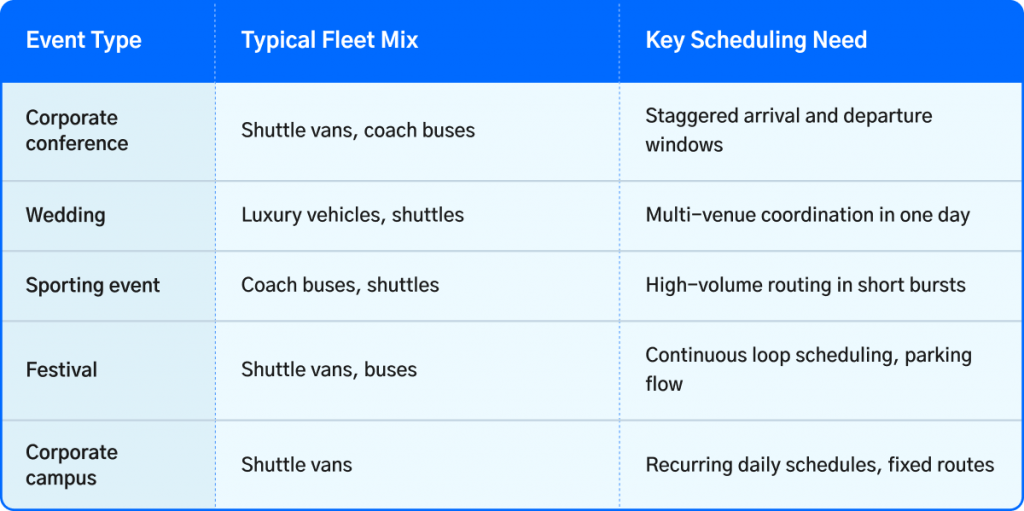
The underlying engine barely changes from one setting to the next. What changes is the configuration around it.
- Corporate conferences and conventions
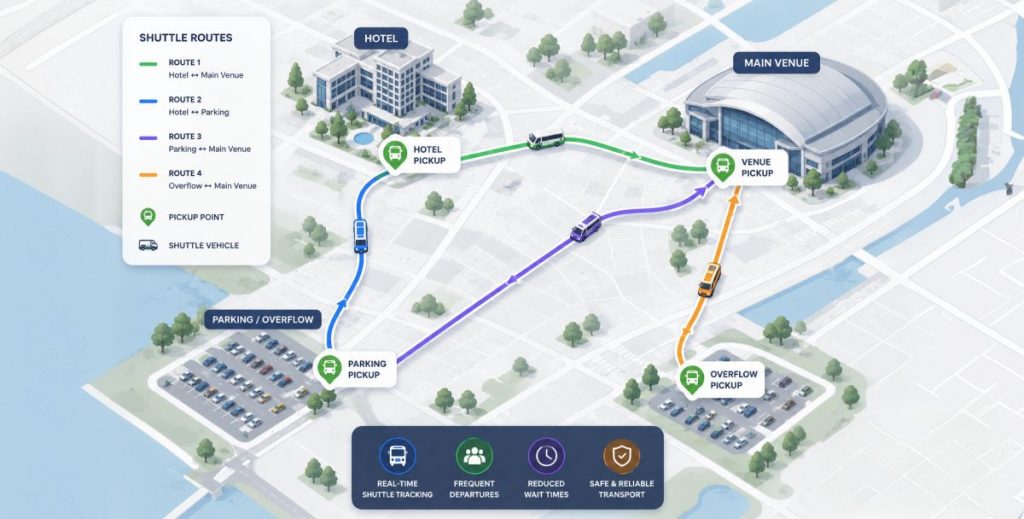
Large scale providers have moved crowds as big as 35,000 attendees using upward of 100 vehicles, holding on time performance around 99 percent. A more typical conference transportation setup involves 300 to 400 delegates across three or four hotels funnelling into one keynote start time, exactly the kind of staggered pickup manual dispatch tends to fumble.
- Weddings
The event scale is often smaller than the rest, with only a few vehicles running. Timing, however, is the key in these cases. Organisers generally arrive an hour before the ceremony begins, especially when the guest list is large. The dispatched vehicles run multiple trips in such cases, and therefore, timing is important. A late shuttle here doesn’t slip by unnoticed, but delays the whole ceremony. Multi-venue transportation across a hotel block, ceremony site, and reception venue is fairly standard here, even for a single day.
- Marathons and sporting events
Races with tens of thousands of runners often split start times into several waves, each needing its own transportation window. The New York City Marathon runs five waves with bus departures from as early as 5:00 a.m. through mid-morning, a schedule with little room for a late bus.
- Festivals
These run on continuous shuttle loops rather than single pickup windows, often across multiple days, with parking lots filling and draining in waves. Event transport solutions built for this use case lean on demand-based resource balancing, adding vehicles to a loop as queues grow rather than running a fixed schedule regardless of turnout.
- Corporate campuses
This is the steady, recurring cousin of the others: fixed routes and everyday employee shuttle runs, where consistency matters more than handling a single chaotic day.
Corporate event transportation and everyday campus transport might not seem to share one software solution, but the platform is the same, just tuned differently. Planners tasked with corporate event transportation for the first time are often surprised at the level of automation it offers.
What Is the Business Impact and ROI?
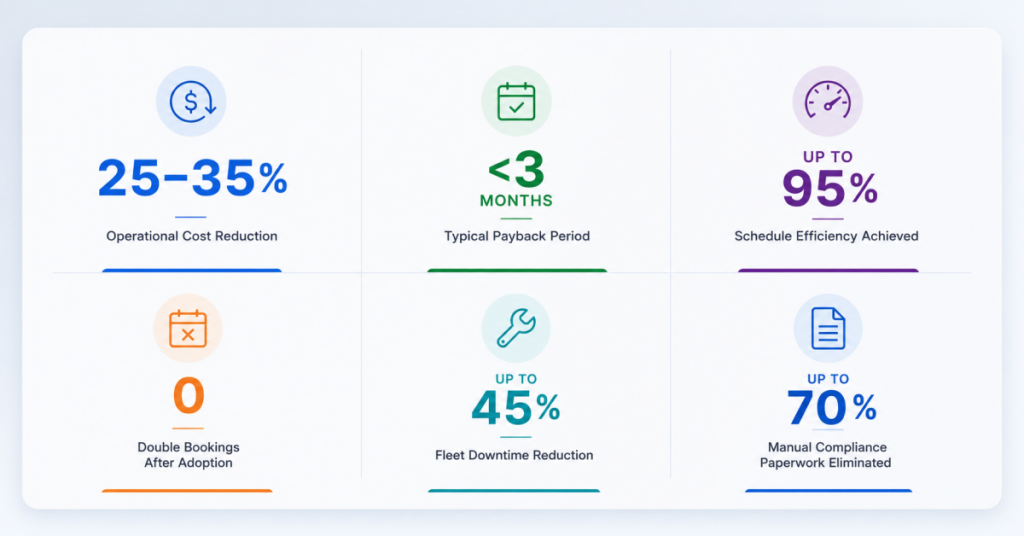
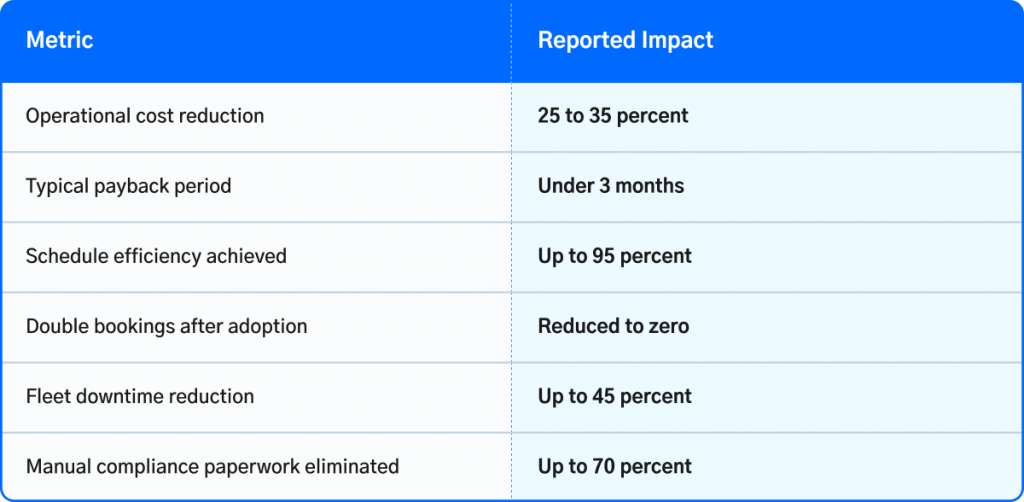
Here’s where the case for reliable event transportation solutions stops being about convenience and starts being about the ledger. Fleet operators quickly begin reporting substantial operational cost reductions using these platforms. Savings show up across a few predictable places: labor efficiency, reduced vehicle downtime, fuel, and fewer scheduling conflicts eating into productive hours. For teams managing passenger transportation at scale, these savings tend to compound across a full event calendar.
Moreover, Guest satisfaction, brand reputation, and the relief of not fielding a crisis call an hour before doors open matter. Even if they resist tidy measurement, it’s probably the harder sell internally, but it’s no less real for being harder to quantify.
How Do You Choose the Right Platform?
The right fit depends on fleet size, event frequency, and how much complexity your team can absorb. This is also where shuttle dispatch software and full event logistics software start to diverge, since one solves a narrower problem than the other.
- Does it handle both event day surges and steady, everyday fleet needs without forcing a second tool
- What’s the realistic implementation timeline (lightweight platforms move faster than enterprise ones)
- Does it integrate cleanly with traffic, weather, and payment systems you already rely on
- Can it scale from dozens to thousands of daily assignments without the routing quality falling apart?
- Does it give guests their own tracking view, or is visibility limited to internal dispatch staff?
- How well does it handle compliance and driver certification tracking over time?
Match the platform to your actual volume, not the volume you might hit someday. It’s tempting to buy for the future, but an oversized system can slow a small team down just as much as an undersized one.
Run Smarter, Coordinate Better
Transportation scheduling software closes the gap between manual coordination and what modern events and modern fleets genuinely demand. It benefits both riders and operators at once. Riders get smoother, more reliable experiences, and operators get measurable cost gains for the teams doing the moving. As fleets increasingly mix electric and traditional vehicles, and as events grow larger and more layered, this kind of coordination stops feeling optional. It starts feeling necessary. Perhaps the better question isn’t whether your organization needs this, but how much longer manual processes can realistically keep up.
See how a dedicated transportation scheduling platform could simplify your next event. Reach out to our team for a walkthrough.
Frequently Asked Questions
Q. How is transportation scheduling software different from fleet management software?
Ans. Scheduling software focuses on assignment and routing, assigning drivers to vehicles for particular routes in real time. Fleet management offers more services, with driver allocation and more. It also covers fuel tracking, maintenance, and long-term compliance. While many platforms offer both today, scheduling software in particular is about live vehicle assignment.
Q. Can this software handle last-minute changes during an event?
Ans. Yes, and this is where it earns its keep. If a keynote runs long or a venue swaps its exit gate, a dispatcher can push updated routes to drivers instantly. Guests see the change reflected in their app almost immediately, too. That live responsiveness is really the whole point. Static plans break the moment reality changes course; this kind of software is built to bend with it instead.
Q. Is transportation scheduling software suitable for small events or small fleets?
Ans. Generally, yes. Lightweight versions of these platforms exist specifically for smaller operations, and they can be up and running within a few weeks. A wedding with a fleet of ten vehicles functions with much less manpower and resources, unlike an annual event. Most vendors offer tiered plans that reflect this. Smaller teams often find that automation saves proportionally more time, since they usually have fewer people to absorb manual coordination work.
Q. Does the software work with electric and mixed vehicle fleets?
Ans. Increasingly, yes. Modern platforms can manage electric and diesel vehicles side by side in one dashboard, factoring in charge levels when assigning routes so nobody gets stranded during the trip. As more fleets add EVs without fully retiring older vehicles, this kind of mixed fleet visibility is becoming less of a feature and more of a baseline expectation.
Q. Can transportation scheduling software manage multiple event venues?
Ans. Indeed, this is one of the most common practical applications. For example, a single event (such as a wedding or a business conference) usually includes not only a hotel where people are accommodated but also a place where a ceremony takes place (or a presentation session) and a venue for the reception. All of these venues are included in a schedule of one fleet as separate stops instead of being considered separately. This approach to venue transportation allows for adjusting the schedule automatically if one of the stops turns out to be delayed.