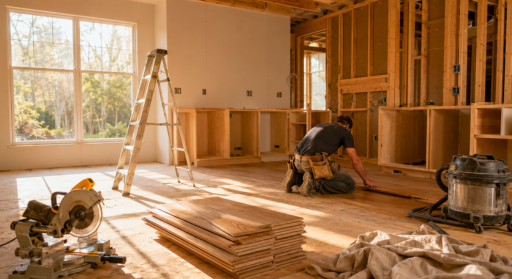
Renovation projects often do not qualify for a standard mortgage. Traditional lenders underwrite the property in its current condition, and a distressed home with major repairs, an outdated kitchen, or a damaged roof may not meet conventional property standards. Fix-and-flip loans are designed for that gap.
A fix-and-flip loan helps investors buy a distressed property, fund the renovation, and repay the loan when the finished home is sold. Because the loan is built around the project’s future value and short-term exit, it works differently from a regular mortgage. The pricing, approval process, closing speed, rehab draws, and repayment timeline all reflect the risk and timing of a renovation deal.
That structure matters not only for investors, but also for real estate agents and advisors working with flip clients. Understanding how fix-and-flip financing works helps them evaluate offers, set realistic timelines, and identify whether a deal has enough room to close, renovate, and resell profitably.
What Is a Fix-and-Flip Loan?
A fix-and-flip loan is a short-term loan, usually lasting six to eighteen months, made for buying and renovating a property with the plan to sell it. Instead of a traditional 30-year mortgage, the loan is built around the timeline of the project itself.
Most fix-and-flip loans are interest-only and require interest payments each month, not principal. That keeps the monthly cost lower while the investor is still mid-renovation and not yet earning anything from the property. Once the house sells, the investor pays off the full loan balance in one lump sum from the sale proceeds.
Why Speed Often Matters More Than Price
Many of the best flip opportunities come from off-market deals: a wholesaler, an estate sale, or a distressed seller who needs to move quickly. A buyer who can’t close fast usually loses that deal to one who can.
This is one of the main reasons fix-and-flip loans exist alongside conventional mortgages. Because these lenders focus on the property and the project rather than a lengthy income-verification process, approvals and closings tend to move in days, not months. That speed is often what makes a good deal possible in the first place, regardless of price.
How Much of the Deal Does the Loan Actually Cover?
A fix-and-flip loan typically pays for two things: most of the purchase price, and some or all of the renovation budget. Lenders usually release the renovation money in stages as the work gets done, rather than handing over the full amount upfront.
That structure matters because it changes the investor’s cash requirement at closing. A typical fix-and-flip loan can finance up to 90% of the purchase price and 100% of the renovation budget, with the total loan amount capped by the property’s after-repair value.
Ridge Street Capital uses this structure for fix-and-flip loans in 35 states, giving investors a practical way to finance both the acquisition and the rehab under one loan.
Here’s roughly how the numbers can play out.
Say an investor buys a property for $220,000 and budgets $70,000 for renovations. A loan covering 85% of the purchase price and the full rehab amount comes to about $257,000, leaving the investor to bring roughly $33,000 plus closing costs to the table.
If the renovated home sells for $370,000 – that needs to be compared against the after-repair value estimate and comps analysis- the investor pays off the loan, covers the agent’s commission and several months of interest and holding costs, and still walks away with somewhere around $70,000 to $75,000 in profit.
Here’s roughly how the numbers can play out on a typical deal.
| Purchase Price | $220,000 |
| Renovation Budget | $70,000 |
| Loan Amount (85% of Purchase + 100% of Rehab) | $257,000 |
| Investor Cash to Close | ~$33,000 + closing costs |
| Sale Price | $370,000 |
| Estimated Profit (after loan payoff, commission, and holding costs) | ~$72,000 |
Why the Local Market Changes the Math
The loan only funds the deal. Whether the deal actually makes money depends heavily on where the property is.
Two markets with the same purchase price can produce very different results. In a market where renovated homes sell in about a month, an investor pays less in interest, taxes, and insurance before the sale closes. In a market where homes typically sit for two months or longer, those same carrying costs eat further into the profit, even if the renovation itself goes exactly as planned.
Property taxes and insurance costs also vary widely by state, and both keep accruing for as long as the investor owns the property. Local competition among investors adds another layer, since a market with many active flippers bidding on the same distressed properties can push acquisition prices up before renovation even starts. A comparison of where flip margins are strongest right now shows just how much these local factors can shift the numbers, even for a similar renovation on a similar home.
What Actually Eats Into Flip Profits
Renovation budgets run over more often than they come in on target. A contractor’s bid that looks unusually low is a common warning sign, and most experienced investors build in an extra 5 to 10 percent for surprises.
A longer-than-planned hold is another common problem. Every extra month adds interest, taxes, insurance, and utility costs, even if nothing else about the project changes. A project that runs two months past schedule can quietly erase a meaningful share of the profit that looked solid on paper at the start.
A purchase price that’s too high is the hardest mistake to fix later. A common guideline is to pay no more than about 70% of what the home should be worth after renovation, minus the renovation cost itself. It’s a starting point for judging a deal, not a guarantee that the numbers will work out, but it helps investors avoid the trap of assuming a strong resale price will cover an already-thin purchase.
A Few Questions Worth Asking Before You Commit
Before moving forward on a flip, a few questions tend to separate a good deal from a risky one:
- What will the home realistically sell for once it’s renovated, based on recent sales nearby, not asking prices?
- How long do renovated homes in this area typically take to sell?
- What’s the true renovation budget, including a buffer for surprises?
- What are property taxes and insurance likely to cost during the holding period?
- Does the purchase price leave enough room for all of the above, plus a profit?
None of these questions have a universal right answer. But investors who ask them before signing a purchase contract spend far less than those who find out the answers halfway through a renovation.