A support ticket rarely lives in one system. It can touch an order database, an inventory tool, and a payment gateway before anyone closes it out. Order changes and internal approvals move through the same kind of chain, passing across several handoffs that a person used to manage by hand. Banking, retail, healthcare, and logistics teams all run this volume daily, and that scale is fueling real demand for a proven AI agent development company.
This guide walks through what an enterprise AI agent project looks like in practice. You will learn when a custom build justifies its cost, what a capable development partner delivers at each stage, and how a small pilot grows into a dependable production system.
What Are AI Agents And Why Enterprises Need Them
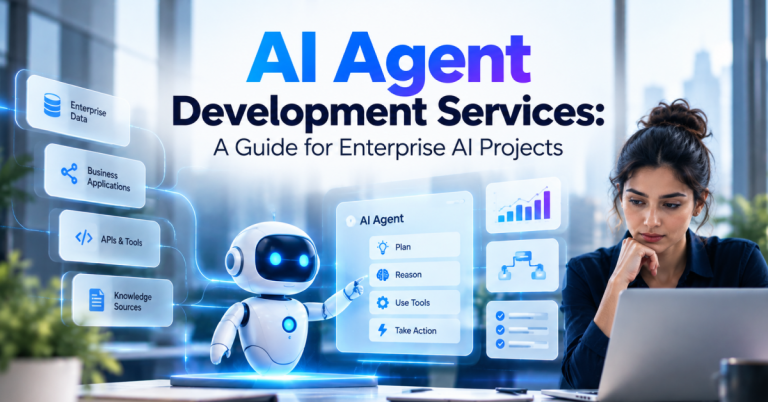
An AI agent plans a task, acts on it, and adjusts when something changes. It does not stop after one answer. Building that persistence is the job of a modern AI agent development company, particularly when enterprises need to integrate intelligent automation into broader enterprise AI development initiatives.
That matters because most enterprise work is not a single question. A refund request alone can involve an order lookup, an inventory check, and a payment system call. A person used to juggle all three manually.
-
From Chatbots To Autonomous Agents
Traditional chatbots follow scripted flows built for questions someone anticipated in advance. Step outside that range and they hand off to a human or simply fail.
Autonomous agents work differently. They reason about the goal itself, break it into steps, and call the tools each step needs. A support agent can look up an order, check inventory, calculate a refund, and issue it in one pass. No handoff required. Getting this reasoning layer right is the core problem serious AI agent development services are built to solve.
-
What Makes An Agent Different From A Script
Irrespective of the requirement, a script always runs the same sequence. Contrarily, an AI agent analyses the steps needed for a particular case. It then adjusts the order or skips a step when the data calls for it, offering a personalized solution.
Order volumes spike during a sale. A backend system goes down without warning. Customer requests range from trivial to genuinely tricky. A well-built agent adapts to all of that, checking a fallback data source or waiting on a slow API instead of failing outright. A script just breaks the moment reality stops matching the plan it was written for.
When To Choose AI Agent Development Services Over Off The Shelf Tools
Not every workflow needs a custom build. Complexity, scale, and how deeply the process sits inside your existing systems usually decide it.
Signs You Need Custom AI Agent Development
Watch for these signals before deciding.
- Three or more internal systems that do not talk to each other today
- An auditable record required for every automated decision
- Off the shelf tools already capped on volume or data residency
- Judgment calls a generic pre-trained model has never seen
Custom AI agent development earns its higher price tag when your workflow is genuinely specific to how your business runs, not something a template can copy.
Signs An Off The Shelf Tool Still Works
A packaged tool handles narrow, repeatable tasks well. Scheduling assistants and basic FAQ bots rarely justify a custom build, and a template usually gets you live faster than a from-scratch project would.
Keep the custom budget for workflows that move revenue, cut real risk, or free up capacity your team does not currently have. A retailer routing simple returns through a packaged bot, while reserving custom engineering for fraud checks and warehouse coordination, is making exactly this trade-off correctly.
What An AI Agent Development Company Delivers
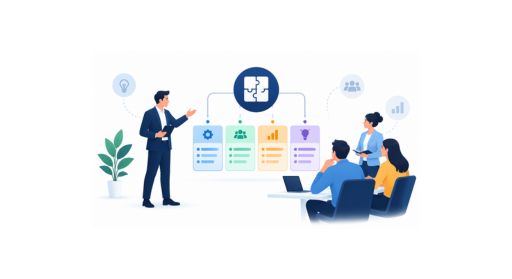
An experienced AI agent development company moves through four important stages.
- Discovery and use case mapping
- Architecture and orchestration
- Integration with live systems
- Testing, guardrails, and governance
Discovery And Use Case Mapping
Good discovery includes every handoff, every approval gate, and every system touchpoint the process depends on. A skilled AI agent development company team sits with the people who run the process daily, not just the manager who describes it from memory.
It also flags which parts of the workflow genuinely need autonomy.
- Not every step needs independent decision-making
- Forcing autonomy everywhere adds risk without adding value
- A strong discovery phase says so plainly, even if it shrinks the project
Architecture And Orchestration
Orchestration decides how several agents share one workflow. Picture a billing agent and a support agent that both touch the same customer record. Someone still has to decide which one acts first when their instructions clash.
Skip this step, and the agents work fine alone but conflict once deployed together. That conflict rarely shows up in testing. It shows up in production, in front of a real customer, which is the worst place to find it. Strong AI agent development services catch this during architecture review, long before code gets written.
Integration And Standards
Agents only create value once they reach production data, not a clean demo dataset built to impress a buyer. Standards such as MCP now let agents connect to several systems through one shared protocol instead of a custom build for every tool.
That change matters more than it sounds.
- Fewer one-off integrations to build and maintain
- Faster rollout across new systems as the business grows
- A shared foundation the next project can reuse
Mature AI agent development services treat this integration layer as core engineering, not an afterthought bolted on before launch.
Testing, Guardrails, And Governance
Before launch, the agent faces edge cases, adversarial inputs, and deliberate failure scenarios built specifically to break it. A good testing plan tries to make the agent fail on purpose, long before a real customer gets the chance to do it by accident.
Guardrails define what the agent can do without a human sign-off. Governance logs every action for audit purposes. Any capable AI agent development services provider insists on this step before launch, because skipping it to hit a launch date is the single most common reason enterprise agent projects stall after they go live.
Core Capabilities To Evaluate Before You Sign A Contract
A written scorecard makes vendor comparisons far easier. Use it to test whether a prospective AI agent development company matches its pitch, and the table below is a good starting point.
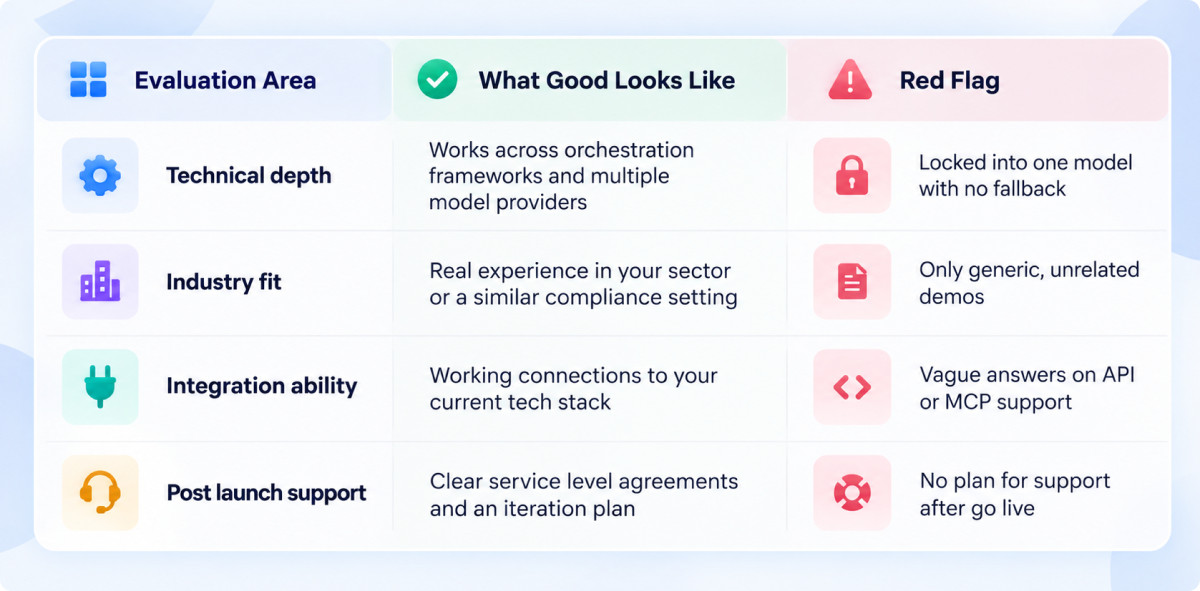
Before signing, ask a vendor these questions directly.
- How do you handle a model failure or a hallucinated output in production?
- What happens to this system a year from now, once your team has moved on?
- Which of your past projects looked like mine, and what broke during them?
A vendor who answers plainly, including admitting past failures, is usually worth hiring. One who deflects, or only talks about capability and never what went wrong, is a warning sign on its own. A dependable AI agent development company treats this scrutiny as routine, not as an inconvenience.
Common Enterprise Use Cases For AI Agents
Adoption clusters around a few areas with strong, measurable payback.
Customer Support And Service Operations
Agents handle routine tickets end to end and escalate the rest with full context attached, so nobody repeats their story from scratch. This is often the first workflow companies hand to an AI agent development company, because the payback shows up fast.
- Pulls account history and order details instantly
- Resolves simple requests without a queue
- Routes complex cases to a person with context intact
- Cuts resolution time while easing the load on live agents
Sales And Revenue Operations
Reps spend less time on data entry and more time on conversations that need judgment.
- Qualifies inbound leads against real account activity
- Updates CRM records automatically
- Drafts outreach grounded in actual behavior, not a template
- Flags stalling deals before a manager notices in review
Internal Knowledge And IT Operations
Employees get answers without filing a ticket and waiting for someone to pick it up.
- Finds policy documents on request
- Resets access without a help desk queue
- Reports outage status in real time
- Flags infrastructure anomalies before they escalate
These three areas rarely stay separate for long. A company that starts with custom AI agent development for support often finds the same underlying agents useful for sales or internal operations within a year.
Risks And Challenges To Plan For
Every project like this carries real risk. Planning for it early costs far less than fixing it after launch.
Data Quality And Access
An agent is only as reliable as the data behind it, and no AI agent development services engagement can fix a broken data foundation with clever prompting alone.
- Fragmented or outdated records produce confidently wrong answers
- A wrong answer stated with confidence damages trust faster than a stated “I don’t know”
- An early data audit catches more problems than later model tuning
Change Management
Employees need real training on working alongside an agent, not a surprise tool on their desktop one morning.
- Unclear boundaries between agent and human work breed resistance
- That resistance can stall a working project without anyone noticing why
- Clear roles and escalation paths ease the transition
Governance And Oversight
Autonomous action without oversight creates compliance exposure that regulators watch closely, particularly in finance and healthcare.
- Escalation rules keep a person in the loop on consequential decisions
- Audit logs support both legal defensibility and customer trust
- Building oversight early costs less than retrofitting it later
Any serious AI agent development services provider raises these risks unprompted, well before a contract is on the table.
A Practical Roadmap From Pilot To Production
Moving from an idea to a working agent works best in stages, not one large leap.
Step One: Pick One High Value Workflow
A narrow pilot with clear metrics proves value faster than an ambitious first attempt that tries to do everything at once. Resist the urge to demo every capability in round one.
Step Two: Measure Honestly Before Scaling
Track accuracy, resolution time, and how often the agent escalates. Share the failures along with the wins, because that honesty earns the next budget approval.
Step Three: Treat The Vendor Relationship As Ongoing
Systems that work today will need retraining and new integrations a year from now. An established AI agent development company that already understands your architecture saves real time on every project that follows.
The Bottom Line On Enterprise AI Agents
Strategy comes first in every successful enterprise AI agent project, and the technology decisions follow only once that groundwork is done. A dependable AI agent development services partner brings solid architecture, well-tested guardrails, and integration work built around the systems already running in your business.
Pick one workflow and measure it honestly. Scale only once the numbers justify it, treating that first release as a foundation for what comes next rather than the finished product. Patience beats speed here almost every time. It also gives every future project, in-house or through an outside agency, a considerably smoother launch.