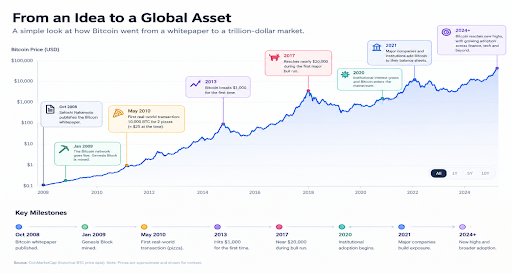
Before we can get to grips with how cryptocurrencies function, the reason why they are so numerous, and whether they are worth considering as investments, we need to begin with the very first cryptocurrency ever created, Bitcoin. The idea of Bitcoin was born out of the global financial crisis as an alternative to the traditional banking system. Satoshi Nakamoto, the author (or rather the authors) of the groundbreaking research paper entitled “Bitcoin: A Peer-to-Peer Electronic Cash System” (Nakamoto 2008) took on the coming financial crisis in his own libertarian and technocratic fashion: replace all the broken institutions and even governments that got us here with a completely transparent and self-governing system that will automatically reject all transactions that will not pass security clearance and prevent coins from being double-spent.
When banks were going bust, Satoshi inscribed in the code of the very first mined Bitcoin block this message: “The Times 3 January 2009 Chancellor on brink of second bailout for banks.” Since then, a lot has been done in the field of cryptocurrencies that went far beyond Bitcoin itself. This article aims at giving a general review of what cryptocurrencies are and how they work, as well as including the risks associated with them, how they can be valued and their long-term prospects.
Though Bitcoin was developed in a libertarian framework, governments have played an indirect role in cryptos since the introduction of stablecoins which are usually pegged to a fiat currency. Stablecoins have become a major mode of payment in the crypto currency industry. Tether, for instance, is the world’s most famous stablecoin and is widely accepted as the most popular trade pairing with many other cryptocurrencies Cryptopedia (2022). Stablecoins avoid the risk of volatility by having their value pegged to an underlying asset. The most popular stablecoins are pegged to the US dollar. There are stablecoins that are backed by assets and managed by a central body and then there are cryptos that try to stabilize their peg using algorithms. One of the most important events was the announcement of Libra (now known as Diem) by Facebook, which was to be a stablecoin for use across all its global platforms and was going to be pegged to multiple currencies which are dominant across the globe (Auer et al. 2020). This event caused panic about the possibility of monetary policy being disrupted by a private currency and seemed to expedite China’s digital currency project (Nikkei Asia, 2020).
THE CRYPTO BACKSTORY
Go back to the Global Financial Crisis for a minute. For many people, this disaster and the response of the institutions involved brought to light many issues with the current financial system. Satoshi, who invented Bitcoin under a pseudonym, thought there had to be a better way to fix the flaws of the financial system built upon intermediary and third-party transactions. This alternative financial system envisioned by Satoshi would empower the people to take control and responsibility for themselves. This system would be decentralized, democratized, and global, with a strong resistance to fraud and rent-seeking activities. At least, these are the features of Bitcoin. But cryptocurrencies created after Bitcoin are different in many ways. However, some general themes (not necessarily rules) can be found in all cryptos, and they are mainly due to mistrust towards traditional institutions and fiat currencies as well as a preference for decentralized financial systems, which are listed below. Interestingly, some of the most famous bankruptcies in the digital asset world belong to the projects that are more centralized such as FTX, Celsius Network, and TerraLuna.
The Innovation of Crypto
Blockchain Technology The innovation that Satoshi has introduced is blockchain technology. (Blockchain’s authentication technology was not invented by Satoshi but rather by Haber and Stornetta who were working as scientists at Bellcore Labs; Satoshi was the one to apply it in digital currency.) The main thing about blockchain is that it does not require an intermediary or any blessing from a third party for transactions to take place. It may sound very technical, but we think it’s a revolutionary approach to implementing blockchain technology. According to Matt Levine’s crypto primer “The Crypto Story” “Modern life involves entries into databases.” Databases store important data, such as ownership and others. Think of bank accounts, medical records, property titles, etc. Most of those databases exist online, and only a few are exceptions. The financial system can be considered thousands or even more databases.
These databases housing our information are usually under the control of some centralized authority. The third parties controlling our financial information from our stock trades to our pension accounts are precisely the entities which many people have come to distrust as a result of the Global Financial Crisis and beyond.
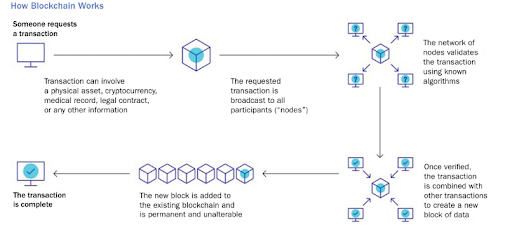
If this system of centralized authorities works right, it does so because these entities serve an important function of confirming transactions, maintaining the trustworthy database of these transactions, and protecting this database from any tampering. If we want to get rid of these centralized third parties, how are we supposed to transact and exchange private information in a reliable manner? How are we supposed to confirm ownership and verify whose information belongs to whom? This is where blockchain comes in. The blockchain is a decentralized database. Rather than depending on some entity (or a few entities) to manage our databases, blockchain depends on a peer network made up of many people connected via computers. Every transaction or database update is shared with the network in the form of a “block” of data. Rather than some controlling entity certifying this block, the peer network agrees upon the current status of the data and blocks
To create a system of incentivizing people for taking part in the blockchain network is through the automatic generation of new Bitcoins and awarding them to the successful completion of the crypto puzzle by these participants. The process of “mining” results in the creation of new blocks in the blockchain, thus forming the distributed ledger (the database not limited to one particular person or authority) where all transactions can be seen by everybody).
Consider the blockchain as the continuous recording of entries where new transaction data is being added to the log. The term “crypto” used in the definition of cryptocurrency stands for the way the blockchain adds every transaction, or forms(blocks) through the use of cryptography. The process of hashing, a cryptographic technology that turns any message of any size into a unique, fixed-sized code called a “hash.” Each cryptographic tool creates a unique hash for each transaction and record. The hash of a property deed would be exactly the same as the identical copy of that deed. However, even if a single letter or number is altered in the copy, the hashes of the two deeds will no longer be identical. Indeed, their difference would be so great that you would never know from simply looking at them that they are almost identical. Each block of the blockchain has a hash of the previous block. Therefore, changing the previous data due to human error or fraud changes its hash and destroys the whole chain. Each block of the blockchain contains other elements of information: a timestamp, a unique identifier, and, of course, the transaction or other data included in this block as a hash. As more and more blocks are added to the blockchain, its data log becomes bigger and bigger (see Exhibit 5). In Bitcoin’s case, the transaction data are stored in each block, with each block having about 2,000 transactions. A block is generated by design about once every 10 minutes.
Keys For Extra Security
Satoshi envisioned developing a ledger for transactions that would combine the privacy of the banking system with the transparency of the Internet. We have seen how blockchain ensures that the details of transactions or any other information are kept private and secure through hashing. But how does Bitcoin link the transactions and any other information to an individual? Bitcoin accomplishes this through an identity called the key. Just like usernames and passwords, a public key serves as the blockchain username of the individual whose transactions it is. In reality, advanced Bitcoin users have several public keys, and those transacting on centralized exchanges do not have their own public key. To be able to spend or transfer a cryptoasset or digital asset, you will need to authenticate yourself by providing another key, which is the private key. Just like usernames and passwords, the private key acts as the blockchain password. Through your public and private keys, the blockchain will be able to confirm that you own a particular digital asset and can transact it More importantly, private keys are highly secure such that even if a supercomputer were to start running since the Big Bang still would not have guessed a private key-private key pairing. The security of your Bitcoins depends entirely on how securely you keep your private keys. This has led to the common mantra heard among cryptocurrency investors: “Not your keys, not your crypto.”
CONCLUSION
In this essay, we have attempted to examine the functioning of private digital currencies – commonly known as “cryptocurrencies,” or cryptos, and how to look at them as investable assets. Cryptos have often been sensationalized; however, the technology behind them has much greater potential. This is the technology of a new decentralized database system. Combining blockchains with smart contracts will enable many opportunities for keeping records and performing transactions. Despite the fact that the technology of blockchain has some practical limitations. There is an increasing number of enterprises operating across digital asset markets and offering various products built using distributed ledger technology. Such enterprises include IBM Blockchain, Microsoft Azure Blockchain, Oracle Blockchain Cloud Service, and Quorum of JP Morgan. For those people interested in blockchain technology and hesitant about cryptos, we believe that it would be useful to study the possible applications of the blockchain technology and its disruptive potential in different spheres of life and operations. We expect that the gap between digital investable assets and distributed ledgers being used for private, governmental, and business purposes will only grow. As the first generation of blockchain technology applications, cryptos might turn out to be dead ends from the evolutionary perspective.