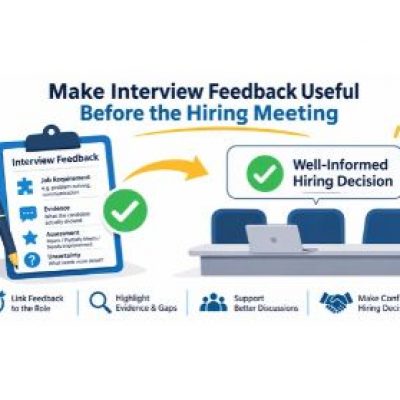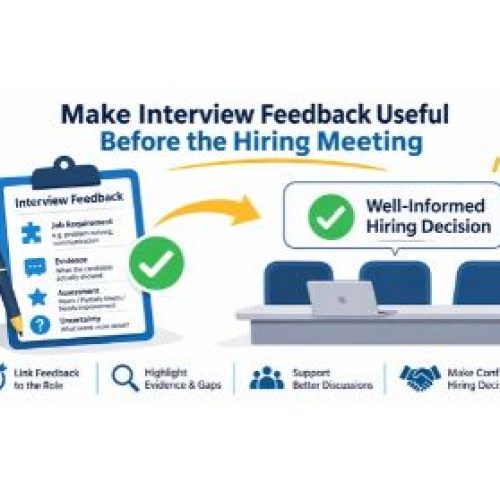
Interview feedback becomes difficult to use when it records a conclusion without showing how the interviewer reached it. A hiring manager receives “strong communicator,” “not strategic enough” and “good fit,” then has to reconstruct the evidence during a meeting. The panel can spend its time comparing impressions while important questions about the work remain unanswered.
A useful feedback record connects a job requirement to something the candidate actually explained or demonstrated. It also identifies the limits of that evidence. This gives the next reviewer a starting point for discussion without pretending that one interview establishes everything about a person’s ability.
Agree what the interview should establish
Begin with the work the successful candidate will perform. For each interview stage, choose the requirements that stage can reasonably assess. A technical conversation, a discussion of previous responsibilities and a work sample may provide different kinds of information. Asking every interviewer to assess everything can produce repetition without resolving the important uncertainties.
The U.S. Office of Personnel Management describes structured interviews as using predetermined questions and common standards to assess job-related competencies. That principle provides a useful foundation: decide what you need to learn and what a relevant answer would contain before comparing candidates.
Consider a fictional business hiring a customer operations supervisor. One requirement is coordinating a response when a service problem affects several teams. An interviewer might explore how the candidate identified the problem, assigned responsibility and checked that the response was complete. “Confidence in the meeting” answers a different question and should not replace that assessment.
Separate the answer from the interpretation
Record the relevant part of the answer before writing the overall assessment. The note does not need to reproduce every sentence. It should preserve enough detail for another reviewer to understand the example and the candidate’s own contribution.
In the fictional supervisor interview, a useful observation might be: “The candidate described collecting unresolved cases from two teams, asking each team to name an owner and checking progress at the end of the shift.” The interpretation could then explain whether this demonstrates the level of coordination required by the vacancy.
Keep team achievements distinct from individual responsibility. If the candidate says “we changed the process,” ask which part they owned. The answer may show meaningful collaboration without establishing that they designed or approved the change. Feedback should preserve that distinction rather than quietly upgrading participation into leadership.
Name the remaining uncertainty
An incomplete answer can mean several things. The candidate may lack the experience, may have misunderstood the question or may not have been asked for the detail the panel now wants. Those possibilities require different responses.
Write what remains unknown in a form someone can act on. “Need more depth” leaves the next interviewer guessing. “The example covers a single shift; responsibility for a problem lasting several days has not been explored” identifies a specific gap. The panel can decide whether that gap matters and whether another question is proportionate.
Avoid treating every uncertainty as a reason to add another interview. Check whether the required evidence is already available in another stage. If it is, point to that record. If the uncertainty concerns a requirement that was never agreed, the employer needs to resolve the brief before asking candidates to do more work.
Use ratings only with an explanation
A rating can help organise a review, but it becomes misleading when different interviewers attach different meanings to the same number. Define the scale for the requirement being assessed and ask for a short explanation of the selected rating.
For example, the fictional business might distinguish between recognising a service issue, coordinating a response within an established procedure and improving that procedure with appropriate approval. These descriptions concern observable work. They give reviewers something more specific to discuss than an unexplained high or low score.
Do not manufacture precision by averaging ratings that describe different things. A technical assessment and an interview about coordination may both use five points while measuring separate requirements. Discuss the evidence for each essential responsibility before relying on a combined score to support a decision.
Prepare the discussion before collecting opinions
Ask interviewers to complete their own feedback before the panel discussion. This creates a record of what each person observed and where their interpretation differs. It also makes it easier to identify whether the disagreement concerns evidence, the assessment standard or the vacancy itself.
A short feedback form can ask for the following:
- The requirement and question being assessed.
- The relevant evidence from the answer.
- The interviewer’s assessment against the agreed standard.
- Any material uncertainty and the suggested next action.
Keep the form short enough to complete promptly. Adding fields that nobody uses can encourage copied phrases and delay the review. The aim is a dependable explanation of a judgment, not a transcript or an administrative record that obscures the actual decision.
Resolve disagreements against the role
During the meeting, return to the requirement before asking whose overall impression should prevail. Two interviewers may disagree because they assessed different examples. They may also be applying different expectations to the same answer. Establish which problem you are discussing.
If a new expectation appears, identify it openly. Suppose the fictional supervisor role was approved to manage an existing service procedure, but the panel now wants experience redesigning the whole operation. That is a change to the brief. It should not be presented as though the candidate failed a requirement that was clear from the start.
The hiring manager should record the decision and its basis after the discussion. Where further assessment is necessary, name the specific question it will resolve. Where the existing evidence supports a decision, close the loop instead of leaving the recruitment agency to interpret a collection of unfinished comments.
Review whether the notes support the next action
After a hiring round, review a small sample of feedback records for practical usefulness. Can another authorised reviewer identify the requirement, understand the evidence and see why the next action follows? If not, improve the question or the form before the next round.
Interview feedback is useful when it allows a panel to examine a judgment rather than merely repeat it. A clear connection between the role, the candidate’s answer and the remaining uncertainty gives the hiring meeting a concrete purpose. It helps the team decide what the evidence supports and what still needs to be established.