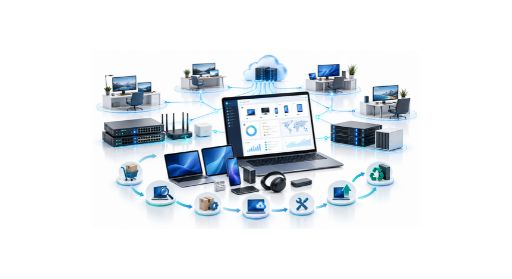
Shipping a laptop to São Paulo from a US-based IT closet isn’t a process, it’s a gamble. For companies with distributed workforces, the gap between how IT hardware gets managed at headquarters versus how it functions for everyone else is one of the most persistent operational headaches in the field. The top IT hardware lifecycle management solutions for distributed teams exist precisely to close that gap.
Managing hardware across remote and distributed teams
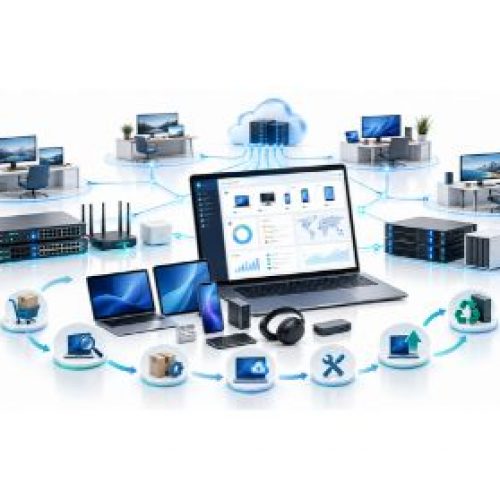
IT hardware lifecycle management software covers procurement, deployment, tracking, retrieval, and disposal in one connected system, which is what distributed IT teams need when devices are spread across time zones and borders. Managing that lifecycle manually means someone on the IT team is constantly chasing couriers, reconciling spreadsheets, and hoping departing employees mail their laptops back.
The vendors below each tackle a different slice of that problem. Some cover the full lifecycle; others specialize in tracking, ticketing, or endpoint management. The list leads with the strongest overall option for distributed teams.
1. Workwize
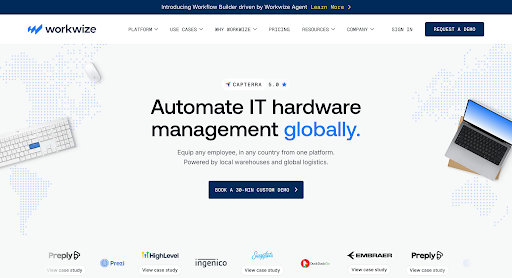
Workwize, IT hardware lifecycle management software, covers the complete hardware lifecycle – procure, deploy, manage, retrieve, and dispose – across 120 countries from a single platform, backed by local warehouses that cut customs delays and cross-border shipping costs. When an HRIS records a new hire or a departure, Workwize fires the corresponding deployment or retrieval automatically. Devices ship pre-configured and MDM-enrolled, so employees are productive on day one without IT manually coordinating each shipment. For teams juggling hundreds of concurrent device assignments across time zones, Workwize eliminates the manual tracking and coordination that would otherwise demand dedicated staff overseeing every regional shipment and return.
The platform manages 120,000+ devices and connects with 80+ HRIS, MDM, identity, and productivity tools, BambooHR, Jamf, Microsoft Intune, Okta, Slack, and more. Every assignment, transfer, wipe, and disposal gets logged automatically in a central registry, delivering 100% chain-of-custody visibility. Retrieval rates hit up to 98% at employee departure, and certified ITAD recovers roughly 45% of device value at end of life. Pricing is quote-based across three tiers, sized by region, team size, and equipment.
Features:
- HRIS-triggered automated deployment and departure workflows
- Local warehouses in 120 countries with typical delivery in 2 to 7 days
- ISO 27001 certified and SOC 2 Type II compliant
- Certified ITAD with roughly 45% value recovery at disposal
- 80+ integrations including HRIS, MDM, and identity tools
2. Work Elevate
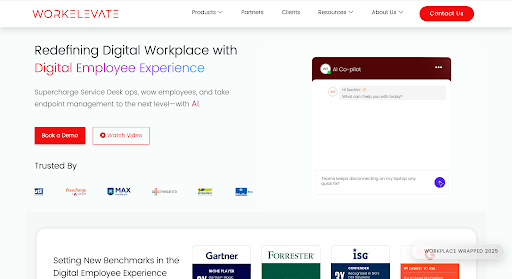
Work Elevate, built by Progressive Infotech and launched in 2018 as AutomateNext before rebranding in 2019, is a digital workplace support platform designed to cut IT ticket volume through AI-driven self-service. Its IT Copilot handles routine issues – password resets, software installs, and troubleshooting – and integrates with ServiceNow, Jira, BMC, ManageEngine, and Freshservice. The platform also ships Digital Employee Experience (DEX) and Endpoint Management modules.
Customer results on file show a 25% to 42% drop in ticket volumes through proactive monitoring and automation. Work Elevate automates up to 70 to 75% of repetitive IT tickets, which matters for distributed teams where the service desk can’t just walk over to a user’s desk. The company is headquartered in Noida, India, has 24 employees, and runs a tiered, subscription-based pricing model. It’s ranked #23 on G2’s Best Indian Software Companies list.
Features:
- IT Copilot for self-service ticket resolution
- Integrations with major ITSM platforms including ServiceNow and Jira
- Automates up to 75% of repetitive IT tickets
- DEX and Endpoint Management modules included
- Subscription-based pricing by users and feature tier
3. Anunta
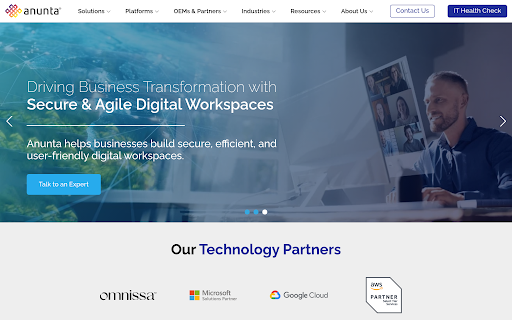
Anunta, founded in 2012 and headquartered in Mumbai, India, specializes in managed desktop and endpoint services for enterprises, with a particular focus on Desktop-as-a-Service (DaaS) and cloud-hosted workspace delivery. Its platforms (DesktopReady™, CloudOptimal®, and EuVantage®) handle deployment, management, and performance tuning of desktop environments across private, public, and hybrid cloud setups.
The company has migrated 1 million remote desktop users and appeared in the Gartner Magic Quadrant for DaaS for four consecutive years. It has raised $3.78M from Bessemer Venture Partners. Partners include Omnissa, Nutanix, Azure, and Hexnode. Anunta’s strength is cloud-native workspace delivery for industries like banking, healthcare, aerospace, and retail, making it a fit when the priority is virtual desktop infrastructure rather than physical device lifecycle management. With around 794 employees, it has the delivery scale to handle large enterprise rollouts. Pricing is not publicly disclosed; the company works on customized, pay-per-user engagements.
Features:
- DaaS with VDI migration, modern desktop, and mobile device management
- Recognized in the Gartner Magic Quadrant for DaaS (four consecutive years)
- Supports private, public, and hybrid cloud environments
- MSP 501 Top 100 ranked
- Industry coverage across banking, healthcare, aerospace, and retail
4. Teqtivity
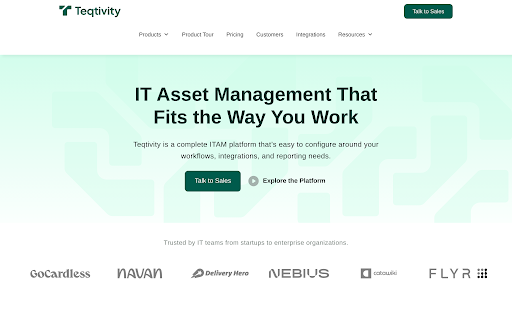
Teqtivity is a California-based IT asset management platform founded in 2017 and focused on tracking devices through the full asset lifecycle (procurement, deployment, storage, maintenance, and disposal). Its user-based pricing model lets teams manage unlimited devices while paying only for the users actively managing assets, which makes costs more predictable as device counts grow.
The platform is built for customization. Teqtivity works directly with each customer to construct workflows and integrations around their specific environment, and its support team functions as an extension of the customer’s IT department rather than a ticket queue. That hands-on approach sets it apart from more self-serve tools. It covers deployment and departure tracking, inventory management, compliance and security reporting, and dashboard analytics. Teqtivity has 11 to 50 employees and serves financial services, education, healthcare, manufacturing, and tech sectors.
Features:
- Unlimited device management, priced per user
- Lifecycle tracking from procurement through disposal
- Customizable workflows built around each customer’s environment
- Deployment and departure asset tracking
- Compliance and security reporting with dashboard analytics
5. Asset Tiger
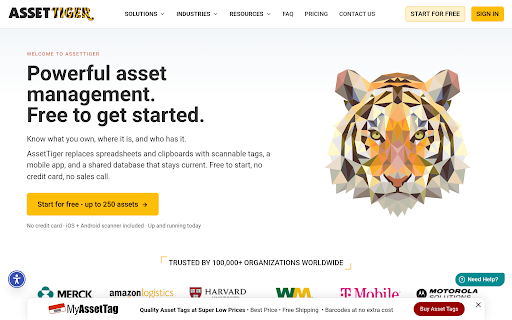
Asset Tiger is a cloud-hosted asset management platform owned by SmartSign, LLC in Brooklyn, New York, the team behind MyAssetTag.com, one of the largest online retailers of asset tags. Built in 2013 to give tag customers a tracking system without the $3,000-a-year price tag, Asset Tiger now serves 100,000+ organizations and is rated 4.6 across 271 Capterra reviews.
Its pricing model is its clearest differentiator: plans scale by asset count, never by the number of users. The whole team is always included. Plans range from a free 30-day trial up to 250,000 assets. Features include barcode and QR code scanning, custody logging, maintenance and warranty tracking with email alerts, consumable inventory management, and 80+ built-in report types covering depreciation, audit reconciliation, and contract expiries. It’s recognized as a GetApp Category Leader and GoodFirms Best Asset Tracking pick.
Features:
- Asset-count pricing with unlimited users across all plans
- Barcode and QR code scanning with check-in/check-out custody logging
- 80+ built-in report types including depreciation and audit reconciliation
- Maintenance and warranty tracking with email alerts
- Scales to 250,000 assets
6. SuperOps
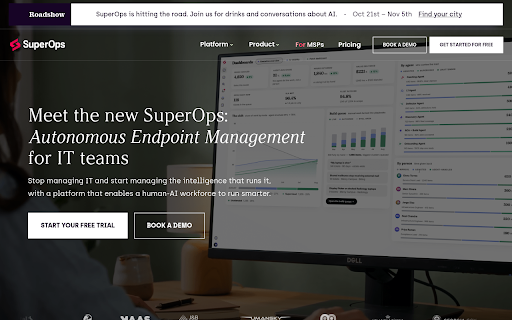
SuperOps is an AI-native IT operations platform founded in 2020 and headquartered in Claymont, Delaware, with a development office in Chennai, India. It serves customers in 104+ countries through two distinct product lines: ITSuite for in-house IT teams and MSPSuite for managed service providers. One system covers UEM, MDM, helpdesk, IT asset management, patch management, RMM, and PSA.
Its main differentiator is that it was built AI-native from the ground up, the platform includes Monica, an agentic AI that moves beyond rule-based automation toward autonomous action. That architecture eliminates data silos that occur when teams stitch together separate ticketing, monitoring, and asset tools. SuperOps raised $54.4M in total funding, including a $25M Series C in January 2025. Pricing runs from $79 to $159 per user or per endpoint depending on the plan, and a free trial is available. The company has 176 employees.
Features:
- Unified ITSuite and MSPSuite covering RMM, MDM, ITAM, helpdesk, and PSA
- AI-native platform with Monica agentic AI for autonomous IT actions
- Serves customers in 104+ countries
- Free trial available; plans from $79 to $159
- G2 High Performer recognition and Category Leader in RMM (Q1 2025)
7. Snipe-IT
Snipe-IT is an open-source IT asset management platform created by Grokability, Inc. in San Diego. With 13 years of operational history, it manages 21.7 million assets across 10.4 million users for roughly 5,960 customers, a large scale for a project that started free and largely stayed that way. Self-hosted deployments cost nothing; cloud-hosted accounts come through premium support plans.
The platform tracks assets, handles user management, supports barcode scanning, and exposes a REST API for custom integrations. Its security architecture includes bcrypt hashing with brute-force prevention, 2FA, HTTPS-only cookies, and a responsible-disclosure process. Cloud hosting runs on AWS with 99.99% availability and data residency options spanning Oregon, Ireland, Singapore, Sydney, São Paulo, and eight other regions. But Snipe-IT’s openness is also its tradeoff, teams without internal dev resources may find self-hosted maintenance demanding.
Features:
- Free and open-source (self-hosted); cloud plans available
- REST API for custom integrations and barcode scanning support
- 99.99% availability on cloud with 12+ global data center regions
- 2FA, bcrypt, and HTTPS-only security architecture
- 330+ open-source contributors with updates released every few weeks
What to look for in hardware lifecycle management software
The right tool depends on whether the team needs physical device logistics or software-layer endpoint control. Those are genuinely different problems. A platform that automates ticket resolution won’t help when a laptop is sitting unclaimed at a departing employee’s apartment in Austin.
For distributed teams, geographic coverage should come first. A solution shipping from a single US warehouse won’t get a device to a new hire in Manila without serious customs friction. Local warehousing in the regions where the workforce actually sits makes a real operational difference.
Automation depth matters too. HRIS-triggered workflows that kick off deployment on a hire event and retrieval on a departure event cut the manual coordination that tends to get dropped. And whatever platform gets chosen should give IT a single audit trail: who has what device, where it is, and what happened to it at departure. Spreadsheets don’t hold that record reliably at scale.
Finally, consider disposal. End-of-life devices carry data security risk and resale value. Certified ITAD built into the platform avoids the step of finding a separate vendor every time a device cycle ends.
Bottom Line
The top IT hardware lifecycle management solutions for distributed teams span full-lifecycle global platforms, open-source trackers, and AI-native IT operations suites. Each addresses a different part of the problem, some start at the physical device, some at the service desk, some at the cloud-hosted desktop. Teams managing physical hardware across borders need geographic coverage, HRIS automation, and audit-ready tracking as a baseline. Teams focused on endpoint control and ticket deflection will find stronger fits in the service-desk and unified endpoint tools on this list.