AI is no longer just helping businesses create content faster—it is fundamentally changing how marketing teams plan, produce, and launch campaigns. Here’s what modern creative workflows look like in 2026.
Introduction
Not long ago, creating marketing assets meant coordinating multiple people across different tools. A designer created graphics, a copywriter drafted promotional copy, a video editor assembled short clips, and marketers stitched everything together into a campaign.
That workflow still exists, but it’s no longer the only option.
Today, AI allows startups, SaaS companies, agencies, and even solo founders to produce professional marketing assets in hours instead of days. Whether it’s generating a landing page hero image, creating social media visuals, or producing a product teaser video, AI has significantly lowered the cost and time required to launch campaigns.
However, one lesson has become increasingly clear: the real value of AI isn’t just generating images or videos—it lies in building an efficient creative workflow.
Organizations that combine AI image generation, AI video generation, and collaborative editing into a unified process are seeing the biggest productivity gains.
In this article, we’ll explore how these technologies are changing marketing in 2026 and how businesses can integrate them into everyday creative work.
Why AI Image Generation Has Become a Core Marketing Tool
Visual content has become the foundation of digital marketing.
Every product update needs a hero banner.
Every blog needs a featured image.
Every social campaign requires multiple visual formats.
Every landing page competes for attention within seconds.
Creating all of these assets manually can quickly overwhelm small marketing teams.
This is where AI image generation has become one of the most valuable productivity tools.
Instead of starting with a blank design canvas, marketers can simply describe the image they want using natural language. Within seconds, AI generates multiple creative directions that can be refined and adapted for different campaigns.
Some common business use cases include:
- Landing page hero images
- Blog illustrations
- Product launch banners
- Social media creatives
- Email marketing graphics
- Digital advertisements
Rather than replacing designers, AI allows them to focus on creative decisions instead of repetitive production work.
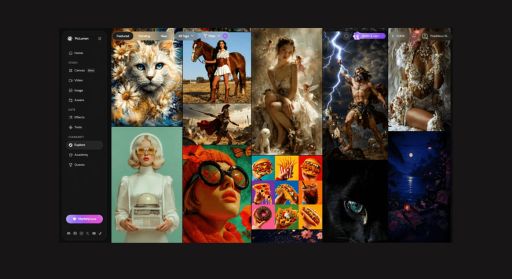
One platform that excellently demonstrates this text-to-image and image-to-image workflow is PicLumen’s AI Image Generation. It enables users to quickly turn creative ideas into high-quality marketing visuals, while supporting diverse creative styles and iterative content refinement.
Why Video Is Becoming the New Marketing Standard
If images dominate websites, videos dominate attention.
Platforms such as LinkedIn, YouTube Shorts, Instagram Reels, TikTok, and X increasingly prioritize motion-based content.
For many companies, however, traditional video production has always been expensive.
Visual storyboarding, editing, animation, and rendering often required specialized software and experienced editors.
Recent advances in AI video generation are changing that equation.
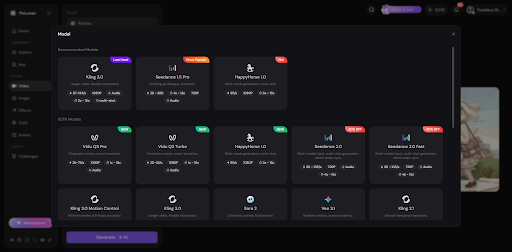
Marketing teams can now create short promotional videos directly from text prompts or convert existing product images into animated videos suitable for social media.
Typical business applications include:
- Product launch teasers
- Software feature announcements
- Event promotions
- Explainer videos
- Social advertisements
- Customer onboarding content
Because AI dramatically shortens production time, businesses can experiment with more creative concepts without increasing production costs.
Instead of producing one expensive promotional video every quarter, marketing teams can now test multiple creative directions every week.
This faster iteration cycle ultimately leads to better campaign performance.
Beyond Individual Assets: Why Creative Workflows Matter More Than Ever
While AI image and video generation have become increasingly powerful, many teams still struggle with a different problem:
Too many disconnected tools.
A typical workflow often looks like this:
Idea → AI Chat Assistant → Image Generator → Photo Editor → Presentation Software → Video Editor → Social Media Scheduler → Publish
Every transition introduces friction.
Files are downloaded, renamed, uploaded again, and duplicated across different platforms.
As marketing output increases, managing creative assets becomes just as challenging as creating them.
This is why many organizations are beginning to shift their attention away from individual AI models and toward integrated creative workspaces.
How AI Canvas Connects the Entire Creative Process
One of the most interesting developments in this space is the emergence of AI Canvas.
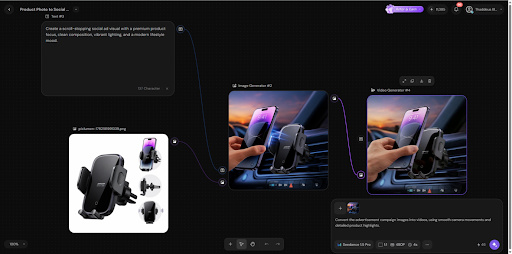
Instead of treating every generated image as a separate project, AI Canvas enables marketers to organize ideas, references, layouts, generated assets, and revisions inside a single collaborative workspace.
This significantly improves creative efficiency.
For example, a single campaign might include:
- Landing page graphics
- Social media posts
- Product mockups
- Advertisement concepts
- Video storyboards
- Email banners
- Presentation slides
Keeping all of these assets inside one workspace makes collaboration far easier than constantly moving files between different applications.
A good example of this approach is PicLumen Canvas, which combines AI generation with an infinite canvas for planning, editing, organizing, and refining complete marketing campaigns.
Instead of focusing on individual images, teams can manage the entire creative process from one place.
Best Practices for Building an AI Marketing Workflow
Organizations adopting AI should think beyond individual tools. Some practical recommendations include:
Build reusable prompt libraries
Well-written prompts become long-term creative assets.
Generate multiple variations early
Comparing five concepts usually produces better results than refining the first one.
Keep brand references centralized
Colors, typography, logos, and product screenshots should remain consistent across campaigns.
Think in workflows instead of outputs
The objective isn’t simply generating an image.
It’s producing an entire campaign efficiently.
Looking Ahead:
The future of AI marketing isn’t about replacing creative professionals.
It’s about removing repetitive production tasks so teams can focus on strategy, storytelling, and customer experience.
Businesses that successfully integrate AI image generation, AI video generation, and collaborative creative workspaces into one repeatable workflow will be able to produce higher-quality campaigns while spending significantly less time on execution.
As AI continues to evolve throughout 2026, competitive advantage will come less from using a particular AI model and more from building smarter creative systems around it.
The companies that embrace workflow automation today will be far better prepared for the next generation of AI-powered marketing.