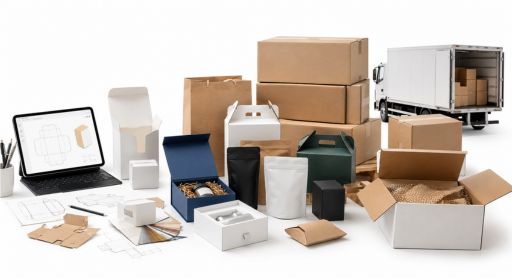
Choosing packaging is no longer about a pretty box. It’s an operations decision that steers cash flow, compliance, and customer satisfaction. New producer-responsibility laws, supply-chain shocks, and rising fulfillment fees now reward brands that work with partners able to think, design, build, pack, and deliver under one accountable roof. We reviewed dozens of contenders, scored them against a four-stage “strategy-to-doorstep” rubric, and selected twelve standouts. What follows explains the method and highlights where each provider excels—helping you match capabilities to your bottom line.
The top full-service packaging companies at a glance
Need a quick shortlist? The table below lists the twelve providers that cleared our four-stage test (strategy, design, production, and final-mile handling) so you can spot a fit before reading the detailed profiles. Scores within three points fall in the same performance tier, so view the numeric rank only as a guide.
|
Rank |
Company | Best-fit programs | Strategy-to-doorstep evidence | Key certifications† |
Warehousing & fulfillment reach |
|
1 |
Zenpack |
High-SKU premium catalogs | California strategy hub; five ISO-certified plants; in-house kitting | ISO 9001, ISO 14001, G7 | U.S. + Asia warehouses; DTC & store delivery |
|
2 |
Menasha Packaging |
North-American retail & displays | 100-person design bench; 2.5 M sq ft omnichannel network | FSC, SFI, G7 Master, ISTA 6-Amazon | 50+ U.S. fulfillment nodes |
|
3 |
RRD |
Regulated, global programs | Packaging + labels + cGMP plants; worldwide kitting | ISO 13485, FDA, cGMP/QSR | 175 sites, 30 countries |
|
4 |
GPA Global |
Luxury, mixed-material scale | Design on three continents; 2 M sq ft global logistics | FSC (site-specific) | U.S., EU & Asia hubs |
|
5 |
Smurfit Westrock |
Enterprise corrugated scale | Vertically integrated mills through recycling | FSC, PEFC, SFI | 500+ facilities, 40 countries |
|
6 |
Berlin Packaging |
Rigid containers & VMI | Studio One Eleven; 6 M sq ft warehousing | ISO 9001 | 100+ global sites |
|
7 |
Veritiv |
Automation & protective packs | 36 design centers; ISTA labs; 60 kitting sites | EcoVadis Silver, ISTA | U.S. & Mexico network |
|
8 |
PAC Contract Services |
Protective flexibles + contract pack | Mailer production plus turnkey assembly | Documentation requested | Multiple U.S. hubs |
|
9 |
TricorBraun |
Bottles, jars, closures | Global sourcing; mold engineering; VMI | Project-specific | 100+ locations, 90 countries |
|
10 |
PCA |
U.S. corrugated & displays | Mill-to-market corrugated; retail fulfillment | ISTA 6-Amazon | 120+ U.S. sites |
|
11 |
Logic Pac |
Beauty gift sets & PR kits | Design → import → QC → influencer fulfillment | FSC options | Salt Lake City DC |
|
12 |
Origin Packaging |
Premium regional mix | Domestic + offshore sourcing; fulfillment | Documentation requested | New Jersey distribution |
† Certificate scope varies by plant. Request the code, scope, and expiry date during due diligence.
The next section defines “full service” and explains why many popular round-ups stop short of the logistics that make or break a launch.
What qualifies as a full-service packaging company
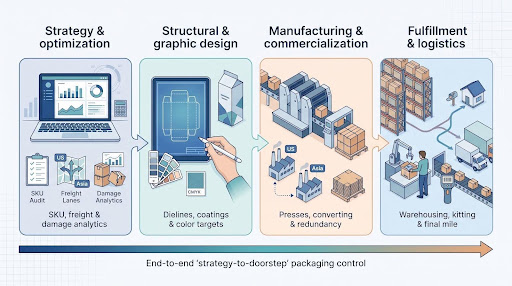
Many suppliers bill themselves as “one-stop shops,” yet subcontract major steps or hand you off to a 3PL once the cartons ship. Our benchmark keeps the label honest: a provider must control, through ownership or binding contract, every step from upfront strategy to the package’s final mile. Miss one stage, and it is not full service.
Strategy and optimization
A credible partner starts with numbers, not sketches. The team audits SKUs, freight lanes, and damage data, then models how lighter materials, revised stack patterns, or SKU consolidation cut cost and carbon. Menasha’s work for a personal care brand selling on Amazon proves the point: reducing 350 box SKUs to five standard sizes trimmed order-to-ship time below 24 hours and dropped mis-shipments under one percent.
Structural and graphic design
Engineers and graphic designers should share a wall, not an email chain. That proximity lets dielines, coatings, and color targets evolve together, speeding sign-off and preventing a branding agency’s files from stalling on press. Expect early white-box samples, digitally printed comps, and on-site transit tests. G7 or GMI certification tied to the exact press line is the minimum bar for color fidelity.
Manufacturing and commercialization
Direct command of presses and converting lines keeps specs locked and schedules firm. Redundancy matters: Zenpack mirrors equipment in Asia and the United States, while Smurfit Westrock’s 57 mills keep linerboard flowing even during regional disruptions. Review ISO 9001 certificates, the latest G7 audit, and ISTA or APASS test reports before tooling money leaves your budget.
Fulfillment and logistics
Value appears only when packaging meets product and reaches the customer intact. A full-service partner should run its own warehouses with scanned inbound checks, climate control where needed, and ERP integrations that update inventory in near real time. Kitting, co-packing, and automation—pick-to-light, right-size carton systems, print-on-demand labels—compress labor minutes and DIM weight.
Regulation raises the stakes. When Amazon phased out FBA prep services in early 2026, sellers without APASS-verified packaging faced non-compliance fees. Providers that own test labs and label lines adapt quickly, sparing you the “We regret to inform you” email.
Dual-site fulfillment (for example, one U.S. and one EU) hedges port delays and cuts duties. Ask for on-time-in-full metrics by region; the best operators track to the decimal.
Bottom line: a partner that offers strategy, design, production, quality, warehousing, kitting, and shipment under one accountable program earns the “full-service” badge.
How we built the scorecard and why you can trust it
Our comparison began with 20 providers that claimed end-to-end service. We checked each claim against annual reports, certificate registries, case studies, and, where available, freight or plant photos. Eight firms missed at least one of the four full-service stages and were removed.
Ten factors, weighted for operational risk
We scored the remaining twelve companies on ten criteria important to operations and supply-chain leaders. Each criterion received a 1–5 rating (5 = current quantitative proof; 1 = marketing claim only) and a weight that reflects its real-world impact:
|
Criterion |
Weight |
| End-to-end integration and accountability |
25% |
| Fulfillment capacity |
12% |
| Manufacturing depth |
12% |
| Quality, testing, and compliance |
10% |
| Sustainability leadership |
10% |
| Program agility |
10% |
| Innovation and digital operations |
8% |
| Geographic reach and resilience |
5% |
| Public case evidence |
5% |
| Independent customer sentiment |
3% |
Raw scores were multiplied by their weights and summed to a 100-point total. Because scoring is granular, any company within three points sits in the same performance tier, avoiding false precision.
Cross-checks before publication
If public claims outpaced plant photos or audit reports, we contacted references and asked for paperwork. Only documented facts, not marketing copy, could change a score. No provider paid for inclusion, placement, or links.
That’s the full audit trail behind the rankings you are about to read.
1. Zenpack: best for high-SKU brands that want one team from concept to customer
Zenpack works more like an in-house packaging department than an outside supplier. After auditing every SKU, channel, and shipping method, engineers and graphic designers collaborate in San Jose, while production runs through five ISO 9001 and ISO 14001 plants in Asia and North America. Central to its approach is Zenpack’s packaging system, which replaces scattered vendors with a standardized matrix of dielines, material specs, and visual guidelines so high-SKU brands can reuse master templates and cut launch timelines from months to days.
Integration delivers real gains. When hair-tool maker T3 Micro refreshed dozens of packages, Zenpack’s standardized dielines and materials cut packaging cost by 20 percent and sped global launches. The same team books ocean and air freight, clears customs, stores inventory on two continents, and kits products with inserts or promo items before final delivery, a plus for influencer or direct-to-consumer drops.
Sustainability runs through the portfolio: FSC fiber, molded pulp, biodegradable trays, and ocean-bound-plastic fabrics appear routinely, and each project ships with a life-cycle summary that procurement teams can paste straight into ESG reports.
Due-diligence tip: ask for plant-level certificate numbers, minimum-order quantities for each component type, and backup production slots; specialty runs can fill Zenpack’s presses quickly during peak season.
2. Menasha Packaging: best for North-American retail, displays, and omnichannel speed
Menasha combines shopper data, structural design, and corrugated production with a 2.5 million-square-foot fulfillment network in the United States. By keeping inventory near major distribution centers, brands replenish stores, e-commerce shipments, and club pallets from one pool of stock.
Design decisions start with point-of-sale and damage analytics. For a personal care brand selling on Amazon, Menasha cut 350 corrugated SKUs to five right-sized boxes, trimming pick-pack time below 24 hours and holding mis-shipments under one percent. The company credits the improvement to data-driven dieline consolidation.¹
Quality checkpoints cover the full route. Many plants carry FSC, SFI, and G7 Master credentials, while in-house ISTA 6-Amazon labs certify SIOC and over-box formats before production. Sustainability shows up in freight savings and RESPONSIPAK plastic-reduction swaps, and the Omnihub model ships finished goods from the closest node to shrink both transit time and emissions.
Know before you quote: Menasha excels in corrugated, displays, and high-volume fulfillment. If your launch needs luxury rigid boxes or molded-pulp trays, confirm capacity or line up a secondary supplier.
3. RRD: best for regulated, multi-country programs that blend packaging and labels
RRD works at enterprise scale: 175 facilities in 30 countries, many holding FDA registration, ISO 13485, and cGMP controls. The footprint keeps a single SKU compliant whether it ships to California, Canada, or Korea.
The company integrates cartons, labels, inserts, and IFUs under one specification. Postponed-configuration lines add lot codes or language variants at the last minute, so inventory stays lean and customs delays vanish.
Regional balance matters too. North-American plants handle quick-turn clinical trials, while Asian hubs run high-volume retail packs. A shared quality system syncs batch records, and a customer portal shows production status, test results, and freight milestones in near real time.
RRD also supports Amazon sellers. After FBA ended in-house kitting in 2026, RRD began re-bagging, labeling, and ISTA-6 testing before inventory reaches a fulfillment center—a safeguard against non-compliance fees.¹
Note for smaller teams: enterprise rigor comes with enterprise paperwork. Confirm minimum order quantities, artwork lead times, and account-management fees before you sign.
When compliance, multi-region supply chains, and relentless SKU change converge, RRD turns complexity into routine.
4. GPA Global: best for luxury, mixed-material packaging at international scale
GPA Global blends luxury aesthetics with engineering that marries wood, metal, paper, textiles, and even electronics into one unboxing experience. Design studios in New Jersey, Hong Kong, and London hand projects to company-owned plants on three continents. The setup lets brands regionalize production to avoid tariffs or meet “Made in USA” claims without losing global consistency.
Scale keeps pace with creativity. A dedicated logistics arm manages more than 2 million square feet of global warehouse space, receiving bulk goods, assembling gift sets, applying serial numbers, and shipping DTC or retail, all under one quality system.
Sustainability is measured, not just promoted. GPA’s latest public report lists recycled-content percentages, mono-material swaps, and site-level energy data. Designers target weight and volume reductions before turning to niche biomaterials, protecting both margin and impact.
Due-diligence tips: luxury complexity can push MOQs higher than commodity corrugated, and certificate coverage varies by plant. Request the exact FSC or ISO codes for the line that will run your order, and confirm capacity during peak gifting season.
If your launch needs a mixed-material package at 500,000-unit scale and logistics to match, GPA Global deserves a spot on your RFP list.
5. Smurfit Westrock: best for enterprise paper packaging and closed-loop services
Formed by the 2024 merger of Smurfit Kappa and WestRock, Smurfit Westrock runs 57 paper mills, more than 500 converting plants, and 30-plus design centers in 40 countries. Fiber, board, printing, co-packing, and recycling all sit on one balance sheet, giving global CPGs a single chain of custody from tree to retail pallet.
Vertical integration safeguards supply. If weather shutters one linerboard mill, another fills the gap without spot-market scrambling, a hedge that keeps shelf dates intact during peak season.
Design depth matches scale: 1,600+ designers tap consumer insights, retail test labs, and automation expertise to fine-tune e-commerce shippers and high-graphic displays. The Better Planet Packaging framework prioritizes weight reduction and mono-material swaps before decorative extras.
Logistics completes the loop. In-plant packaging teams, regional co-packing hubs, and reverse-logistics programs bale used corrugate into fresh board, supported by FSC, PEFC, and SFI certifications that verify responsible fiber flow.
Note for smaller brands: large-scale capacity comes with high minimums. Confirm order sizes, design fees, and account structure early.
For Fortune 500 teams that need global continuity, verified sustainability, and one invoice from forest to finished pack, Smurfit Westrock checks every box.
6. Berlin Packaging: best for rigid containers and VMI
Berlin Packaging pairs Studio One Eleven’s design team with a sourcing engine that pulls from more than 1,700 vetted suppliers worldwide. Buyers can compare boutique Italian glass with lightweight PCR PET in the same line review, then negotiate tooling or mold changes under one contract.
Inventory sets Berlin apart. About 6 million square feet of warehouse space across North America and Europe support a vendor-managed inventory program that moves full pallets to big-box DCs and cartons to contract fillers without tying up your capital. Berlin reports 99 percent on-time delivery; request recent scorecards during due diligence.
Quality scales with volume. ISO 9001 systems cover supplier approval, incoming QC, lot traceability, and in-house torque, leak, and drop tests. Decoration and color matching stay inside the same workflow, so a hot-stamp gold closure lands right the first time.
Sustainability moves from concept to SKU through PCR, refillable, and lightweight options. Engineers model carbon and cost deltas for each scenario, giving finance and ESG teams numbers, not slogans.
Ask before you sign: because Berlin relies on a broad supplier web, confirm contingency plans if a mold fails in Guangdong. Dual qualification is usually smart practice.
If your product story lives in the bottle or jar, Berlin Packaging delivers shelf presence and working-capital relief under one roof.
7. Veritiv: best for engineering-led protective packaging and automation
Veritiv treats packaging like an engineering problem. Thirty-six design centers model crush strength, drop angles, and cube utilization before a cutter touches board, and on-site ISTA-certified labs stress-test prototypes the same day, speeding sign-off and cutting freight damage.
After structure comes automation. Veritiv integrates case erectors, right-size systems, cobots, and vision inspection into existing lines, trimming labor minutes you can track on the P&L. Brands moving to high-speed pick-pack often choose Veritiv because packaging and machinery follow the same playbook.
Fulfillment runs just as deep. Sixty kitting and assembly sites in the U.S. and Mexico handle multi-component fitness devices, retail-ready PDQs, and more. Keeping design, testing, and kitting under one roof removes the hand-offs that slow many mid-launch programs.
Sustainability shows up in hard metrics, not slogans. The EcoScore platform grades each design on end-of-life, recycled content, and material reduction, and an EcoVadis Silver rating backs the claim. Request the latest scorecard to see how your SKUs measure up.
Due diligence: clarify which components Veritiv makes directly versus procures through partners; the network is broad, and transparency avoids lead-time surprises.
If crushed corners, labor bottlenecks, or manual assembly are your pain points, Veritiv is worth a plant tour.
8. PAC Contract Services: best for protective mailers and turnkey fulfillment
PAC started with bubble and poly mailers and has since added design, sourcing, assembly, and distribution, giving brands that ship mainly by parcel one accountable vendor.
The process begins with protective-pack engineers who balance material weight, burst strength, and unboxing experience. Because PAC owns its film lines, adjustments such as gauge changes or higher recycled content show up on the next run, not the next fiscal year.
A dedicated contract-services division closes the loop. U.S. facilities receive bulk product, add inserts, seal shipments into PAC-made mailers, and induct parcels directly into UPS, FedEx, or USPS networks, cutting freight touches and keeping package and contents under one quality record.
Sustainability centers on material reduction and mono-poly designs that fit existing film-recycling streams. Recycled-content percentages vary by SKU; ask for resin-lot documentation.
Due diligence: public data on capacity and certifications is limited. Request plant audits, ISO or SQF proof, and recent throughput numbers before committing, especially if your launch volume is sensitive to lead-time swings.
If you sell small, high-value items and rising return rates point to fragile mailers, PAC Contract Services deserves a close look.
9. TricorBraun: best for bottles, jars, and closures
TricorBraun blends consumer insight, industrial design, and mold engineering with a supply network that spans 90 countries and more than 100 locations. Engineers fine-tune wall thickness and neck finishes, then pit multiple glass factories or plastics converters against one another for tooling bids that keep cost and lead time in check.
Inventory risk drops under the company’s vendor-managed inventory program. Finished bottles and closures sit in TricorBraun warehouses until your filler calls them off, keeping cash flowing and lines running; most U.S. fillers receive replenishment within a day.
Quality stays central. An internal audit team visits factories, retains samples, and issues corrective actions when color drift or thread depth moves off spec. Certifications for food, pharma, and beauty products live in a central portal, streamlining regulatory paperwork.
Sustainability options include PCR PET, lightweight glass, and refill systems, each with life-cycle comparisons. Ask early about minimum order quantities for recycled resin or specialty tints. Availability still varies by region.
Limitation: TricorBraun is strong on components and supply-chain orchestration but does not run large-scale kitting or DTC fulfillment centers. Pair it with a co-packer if pick-and-pack is critical.
For brands whose hero package must be both functional hardware and shelf statement, TricorBraun delivers depth, choice, and global resilience.
10. Packaging Corporation of America: best for U.S. corrugated manufacturing and retail displays
Packaging Corporation of America (PCA) keeps corrugated production entirely inside U.S. borders: nine containerboard mills feed 94 converting plants, giving it end-to-end control from fiber to finished box. For operations teams, that means shorter lead times, simpler freight, and easier plant audits.
Regional design centers prototype e-commerce shippers, pallet skirts, and high-graphic floor displays, then run them through ISTA 6-Amazon labs to verify SIOC compliance before dies are ordered. Because the mills and converting lines share one quality system, color targets and board specs stay locked from trial to millionth unit.
PCA’s merchandising division adds value by building corrugated displays, loading them with product, and shipping ready-to-place units onto retail floors. Fulfillment centers near major retail DCs keep replenishment fast and chargeback risk low.
Sustainability leans on fiber stewardship—SFI-certified liner and OCC recycling programs—plus freight consolidation that cuts truck miles. For paper-first brands, PCA provides circularity without crossing oceans.
Limitations: PCA focuses on corrugated and displays; it does not own rigid-box or molded-fiber lines, so hybrid sourcing may be needed.
For companies that prize domestic supply security, rapid retail turns, and corrugated expertise, PCA offers scale without global-logistics drag.
11. Logic Pac: best for beauty, influencer, and limited-edition kit programs
Logic Pac solves a familiar pain for beauty and lifestyle brands: luxury detail at launch volumes that start near 50 units. The Southern California team blends structural design, sourcing across five countries, in-house QC, and Salt Lake City warehousing, so the project manager who picks paper weight also books freight and oversees hand assembly of ribbon-tied gift sets.
Pre-production samples—including magnets, foam inserts, or LED modules—run through Logic Pac’s own drop and humidity tests before mass build. Brands shipping to Ulta, Sephora, or Target tap the same crew for vendor-compliance paperwork and routing guides, keeping launch calendars on track.
MOQs rise to a few thousand for retail roll-outs. Sustainability options span FSC fiber, recyclable PET windows, and molded-pulp trays. Certificate coverage varies by partner factory, so request the exact chain-of-custody code for your run.
Heads-up: capacity fills fast during peak gifting season, so reserve production slots early. If you need 300 influencer boxes that look couture without pulling your marketing team into carton folding, Logic Pac is worth a shortlist.
12. Origin Packaging: best for premium regional programs with domestic and offshore capacity
Origin Packaging gives mid-sized brands a single point of contact backed by two levers: a converting plant in New Jersey and a sourcing team that taps specialty factories from Europe to Southeast Asia. A design sprint and landed-cost analysis decide whether launch kits run domestically for speed or move offshore for replenishment savings, while color control stays aligned across both.
East-Coast warehousing keeps inbound containers and outbound shipments close to dense retail corridors. The team also kits DTC parcels with tissue, inserts, and coded labels before inducting them into carrier networks the same day.
Sustainability options range from FSC paper to refillable glass and aluminum, but certificate visibility is thinner than peers. Request facility-level FSC or ISO documents, recent audit reports, and social-compliance records during RFP.
Capacity check: Origin shines at premium runs of roughly 5,000 to 100,000 units; larger volumes may depend on partner plants. Confirm slot availability and contingency plans before locking timelines.
If you need boutique creative service, global cost leverage, and inventory parked on the Eastern Seaboard, Origin Packaging merits a look.
Compare the companies by packaging need
High-SKU premium and consumer-electronics programs
Fast refresh cycles and premium unboxing demand partners that keep design, tooling, color, and logistics under one roof.
- Zenpack reuses master dielines across dozens of SKUs, pairs G7 color control with kitting lines, and delivers influencer drops alongside mass production.
- GPA Global adds mixed-material flair: think aluminum accents with foam-free molded pulp, while regional plants keep cost predictable.
- RRD handles multilingual inserts and last-minute lot coding; postponed configuration prints country-specific leaflets days before ship dates.
Many electronics brands blend Zenpack’s speed with RRD’s label discipline; GPA steps in for special-edition finishes.
Omnichannel retail and display programs
One box must survive UPS, nest into a Walmart tray, and stack on a Costco pallet.
- Menasha Packaging couples shopper data with mill specs and feeds designs into a 2.5 million-square-foot fulfillment grid.
- Smurfit Westrock offers fiber from mill to recycling plant, plus 30+ experience centers and global co-packing hubs.
- Packaging Corporation of America keeps it domestic: nine mills, 94 plants, and a merchandising team that ships displays retail-ready.
Choose Menasha for data-driven omnichannel speed, Smurfit Westrock for global continuity, and PCA when U.S. geography is the main priority.
Bottles, jars, closures, and other rigid packaging
- Berlin Packaging runs a 6 million-square-foot warehouse network and vendor-managed inventory so cash stays off the floor.
- TricorBraun taps 1,700+ suppliers in 90 countries; global staging keeps custom molds close to each filler.
Lean on Berlin when working capital and storage dominate; pick TricorBraun when material mix and geography drive risk.
Engineering, automation, and protective packaging
- Veritiv unites 36 design centers, on-site ISTA labs, and automation crews who drop case erectors and cobots into existing lines.
- PAC Contract Services pairs mailer production with in-house assembly, then inducts parcels directly into parcel networks, cutting touches and damage.
Use Veritiv when labor minutes and cube efficiency rule; call PAC for parcel protection and fast kitting.
Beauty, influencer, and gift-set programs
- Logic Pac specializes in MOQs of 50–5,000 units, hand-assembled finishes, and retailer paperwork for Ulta or Sephora.
- GPA Global handles fabric-wrapped keepsake boxes and metallic closures at scale.
- Zenpack reuses inserts across shade launches and adds influencer notes on demand.
Logic Pac suits boutique drops, GPA covers luxe mixed materials, Zenpack wins when SKU churn is relentless.
Regulated healthcare and life-science programs
- RRD combines FDA-registered, ISO 13485, cGMP facilities with clean-room kitting and postponed labeling.
- Veritiv integrates protective-pack design with sterile-line automation and ISTA testing.
- Menasha Packaging adds high-volume retail fulfillment for OTC products, pairing APASS know-how with display speed.
Before awarding, verify current ISO 13485 certificates, deviation-response times, and walk the exact clean-room line that will run your SKU.
How to compare MOQ, lead time, and total packaging cost
Unit price alone hides real risk. Tooling fees, freight, and inventory carrying costs can outweigh pennies shaved off each box. A clear comparison starts with three volume tiers—pilot, launch, and steady state—because setup charges amortize differently at each level.
Break every quote into nine cost buckets:
- Design and engineering hours
- Prototypes and lab tests
- Dies, plates, molds, and color draw-downs
- Per-unit production cost
- In-process and pre-shipment inspections
- Freight and fuel surcharges
- Duties, brokerage, and port fees
- Warehousing and inventory interest (use your own cost of capital)
- Rework, returns, and damage allowances
Ask suppliers to price each bucket or label it included. When two vendors bury freight in a blended unit rate and a third breaks it out, convert all offers to the nine-bucket grid; hidden costs surface fast.
Treat lead time with the same detail. Record days for artwork approval, prototype turn, tooling, production, in-line QC, shipping, customs, and final delivery. Delays often stem from color sign-off or port congestion, not transit itself.
Match MOQ to your sales forecast and cash cycle. Ordering double to satisfy a factory minimum saves money only if you sell through before designs or regulations change.
Do this once, and negotiations shift from price cutting to waste cutting, where real savings live.
Certifications and compliance signals buyers should verify
A certificate is a living specification. If it lapses, your shipment can be detained and your brand fined. Capture four data points every time: code, scope, site, and expiry. Re-check them before each reorder.
Core systems
- ISO 9001 (quality) and ISO 14001 (environment). Confirm that the scope covers “manufacture of printed folding cartons,” not merely “sales of packaging materials.”
- Chain of custody: FSC, PEFC, or SFI. Record product type (for example, FSC Mix) and expiry; auditors will ask for that exact trio.
Color control
- G7 or GMI. Verify which press earned the badge and the date of the last calibration; another plant’s certificate is meaningless to your run.
Transit testing
- ISTA 6-Amazon or APASS reports should quote your exact SKU, not a generic sample from 2019.
Regulated environments
- ISO 13485 and FDA registration for medical devices
- GFSI/SQF for food-contact packs
Review recent audit reports. Repeat “major” non-conformities often predict future delays.
EPR data readiness
Seven U.S. states, starting with Oregon in 2025, now require detailed packaging weight and composition reports. Suppliers should deliver resin codes, recycled-content percentages, and unit weights in a spreadsheet your compliance portal can ingest.
Conclusion:
Bottom line: treat certificates like any other critical spec. Verify the details, track the renewal date, and make re-verification part of your production checklist.