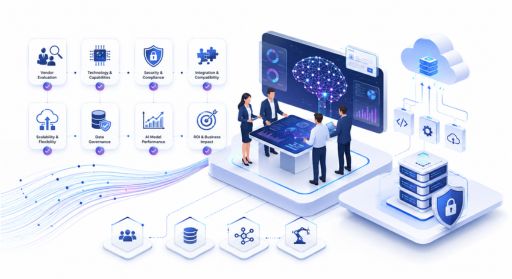
Enterprise AI spending is rising fast, but many organizations are still struggling to turn experimentation into measurable business value. That’s why choosing the right AI services for enterprises has become less about flashy demos and more about long-term usability, governance, integration, and operational fit.
Recent industry research shows that enterprises are becoming more cautious about AI investments due to concerns around ROI, vendor lock-in, data security, and governance failures. At the same time, AI adoption continues to expand across operations, customer service, analytics, software development, and workflow automation.
For buyers evaluating enterprise AI partners or platforms, the challenge is no longer whether to adopt AI. The real challenge is identifying solutions that can scale responsibly and deliver sustainable value.
Start With the Business Problem, Not the Model
One of the biggest mistakes enterprises make is evaluating AI services based on model capabilities alone.
A powerful, large language model means very little if it cannot solve a specific operational problem. Before comparing vendors, enterprises should clearly define:
- The workflows they want to improve
- The teams that will use the solution
- Expected business outcomes
- Risk and compliance requirements
- Existing infrastructure limitations
For example, an enterprise looking to automate internal knowledge management has very different needs than a company deploying AI agents for customer support or supply chain optimization.
The best AI services for enterprises focus on aligning AI implementation with operational goals instead of pushing one-size-fits-all solutions.
Evaluate Data Readiness and Integration Capabilities
AI systems are only as effective as the data they can access and interpret.
Many enterprise AI initiatives fail because the underlying data environment is fragmented, outdated, or difficult to integrate. Buyers should pay close attention to how AI providers handle:
1. Data integration
Can the service connect with existing systems like CRMs, ERPs, cloud warehouses, and internal databases?
2. Data governance
Does the provider support role-based access controls, audit trails, encryption, and compliance requirements?
3. Real-time data access
Can models work with live operational data rather than static snapshots?
4. Structured and unstructured data
Can the solution process documents, emails, PDFs, chat logs, tickets, and internal knowledge bases?
Security and Governance Should Never Be an Afterthought
As AI agents gain access to enterprise systems and sensitive workflows, governance has become one of the most important evaluation criteria.
Industry analysts now warn that many enterprises are deploying autonomous AI systems faster than they can govern them. Security concerns, especially around AI agents and connected tools, are becoming major barriers to scaling deployments.
When evaluating vendors, enterprises should ask:
- How is sensitive data isolated?
- Are there approval workflows for autonomous actions?
- Can administrators monitor AI decisions and activity logs?
- How are permissions managed?
- What safeguards exist against prompt injection or unauthorized access?
Strong governance frameworks are becoming a differentiator in enterprise AI procurement decisions.
A mature provider should also support:
- Human-in-the-loop controls
- Policy enforcement
- Continuous monitoring
- Compliance reporting
- Access governance
Without these capabilities, scaling AI across departments becomes risky very quickly.
Watch for Vendor Lock-In Risks
Vendor lock-in is becoming a growing concern in enterprise AI.
Many organizations are discovering that deeply embedding workflows into a single AI ecosystem can make future migrations expensive and operationally difficult.
This matters even more with AI because workflows, prompts, integrations, and operational logic often become tightly coupled to a specific provider’s infrastructure.
When comparing AI services for enterprises, buyers should evaluate:
1. Model flexibility
Can multiple models be supported?
2. Portability
Can workflows, prompts, and data be exported easily?
3. Open standards support
Does the platform support emerging interoperability standards?
4. Infrastructure options
Can deployments run across cloud, hybrid, or on-premise environments?
Enterprises are increasingly favoring modular architectures that reduce dependency on a single vendor and provide more flexibility as AI capabilities evolve.
Prioritize Scalability Over Pilot Success
Many AI projects work well in small pilot environments but struggle once deployed across the organization.
Scalability involves more than model performance. It includes:
- Infrastructure costs
- User adoption
- Workflow integration
- Governance consistency
- Monitoring and maintenance
- Change management
A vendor should be able to explain how their solution performs under production-scale workloads and how they manage operational complexity over time.
This is especially important as enterprises move toward AI agents and multi-step automation systems that interact with multiple tools and business functions simultaneously.
Ask How Success Will Be Measured
AI adoption is shifting from experimentation to accountability.
Enterprise buyers are increasingly under pressure to justify AI spending with measurable outcomes. Vendors should be able to define clear performance metrics tied to business impact.
These metrics may include:
- Productivity improvements
- Response-time reductions
- Operational cost savings
- Workflow automation rates
- Accuracy improvements
- Employee efficiency gains
Avoid providers that focus only on technical benchmarks while ignoring operational KPIs.
The most effective enterprise AI implementations usually combine technical performance with process optimization and organizational alignment.
Look Beyond Features and Assess Long-Term Partnership Value
AI systems require continuous refinement. Models change, regulations evolve, workflows expand, and organizational needs shift over time.
That means enterprises should evaluate vendors not only as technology providers but also as long-term strategic partners.
Important considerations include:
- Implementation support
- Governance expertise
- Training and onboarding
- Industry-specific knowledge
- Ongoing optimization services
- Transparency around roadmap changes
A provider’s ability to adapt alongside the enterprise may ultimately matter more than having the most advanced model today.
Conclusion:
The enterprise AI market is maturing quickly. Buyers are moving past hype-driven decisions and focusing more on governance, scalability, interoperability, and measurable business outcomes.
Choosing the right AI partner now requires a broader evaluation framework that includes security, operational fit, flexibility, and long-term sustainability.
The organizations seeing the most success with AI are often not the ones adopting the newest tools first. They are the ones building reliable foundations that allow AI systems to scale responsibly across the business.
Explore how BayOne helps enterprises implement scalable, secure, and governance-driven AI solutions aligned with real business outcomes.