If you walk into a typical marketing agency today, you will hear a lot of noise about Artificial Intelligence. You will see teams using tools to generate rapid blog posts, draft basic email copy, or create striking images in seconds.
There is a widespread industry belief that this generative efficiency represents the peak of the AI revolution in marketing. But while most of the market is hyper-focused on automating content creation, a much quieter—and far more lucrative—shift has already taken place.
Deep learning has entered the marketing room. And the truth is, most agencies didn’t even notice.
While generative AI focuses on output, deep learning focuses entirely on outcome. It is the invisible engine behind predictive analytics, dynamic pricing, and algorithmic ad bidding. For business leaders and executives, understanding the difference between surface-level AI utilities and true deep learning infrastructure is the ultimate key to unlocking real campaign intelligence.
The Difference Between AI “Tools” and Deep Learning
To understand why deep learning is a definitive game-changer, we have to strip away the standard marketing jargon.
- Artificial Intelligence is the broad, overarching umbrella.
- Machine Learning is a distinct subset of AI that allows computers to learn from data patterns without being explicitly programmed.
- Deep Learning is a highly specialized further subset of machine learning, powered by artificial neural networks that mimic the structural processing of the human brain.
Most agencies are currently trapped in what is known as Application-Layer AI. They are logging into third-party software to speed up manual tasks. While this is helpful for immediate operational efficiency, it provides absolutely zero long-term competitive advantage because every competitor has access to the exact same tools.
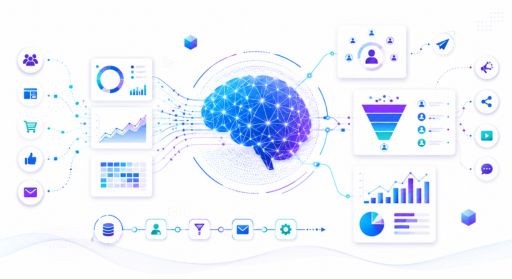
Deep learning, on the other hand, operates at the foundational data layer of a business. It thrives on massive, unstructured datasets—analyzing customer behavior, purchase history, cross-channel interactions, and macroeconomic market trends simultaneously.
Instead of asking, “How quickly can we write this ad copy?” deep learning asks, “Based on five million historical data points, which exact user is most likely to convert on this specific value proposition at 2:00 PM on a Tuesday, and what is the mathematically optimal bid price required to acquire them?”
How Deep Learning is Rewriting Campaign Intelligence
Simple business automation is now table stakes. Sending an automated email when a user abandons their cart is no longer innovative; it is expected. The real gap in the market today is executing true advanced campaign intelligence, and deep learning is filling that void across three crucial areas:
1. Predictive Churn and Customer Lifetime Value (CLV)
Traditional marketing look in the rearview mirror—analyzing what happened last month to manually adjust the strategy for next month. Deep learning looks firmly through the windshield.
By processing complex historical data, deep learning models identify the subtle behavioral shifts that indicate a customer is about to churn before they actually make the decision to leave. Whether a user’s session time drops by a mere 12% or their click patterns change, neural networks flag these micro-patterns and automatically trigger highly personalized retention flows, saving revenue before it drops off the ledger.
2. Hyper-Personalization at Scale
Personalization used to mean putting a customer’s first name in an email subject line. Today, deep learning enables true hyper-personalization at an unprecedented scale.
Consider the enterprise recommendation engines powering modern e-commerce. These deep neural networks analyze not just what a user bought, but what they hovered over, what they skipped, and what lookalike cohorts in their exact demographic purchased. The algorithm then dynamically restructures digital interfaces for that specific user in real-time, displaying the exact offerings they are mathematically most likely to engage with.
3. Programmatic Advertising and Algorithmic Bidding
Modern media buying has evolved far beyond human capacity. In programmatic advertising environments, ad inventory is bought and sold in milliseconds.
Deep learning algorithms evaluate thousands of variables simultaneously—including real-time competitor bids, local economic shifts, and platform performance data—to determine the precise value of a single ad impression. Human media buyers simply cannot process this volume of data at this velocity. Algorithms optimize ad spend with a level of precision that drastically lowers Customer Acquisition Cost (CAC) while scaling Return on Ad Spend (ROAS).
The Real-World Impact: Moving Beyond the Hype
Let’s look at a practical example of deep learning outperforming traditional digital marketing frameworks. Imagine a mid-sized B2B SaaS company running an enterprise lead generation campaign.
- The Traditional Agency Approach: The team might test three different ad creatives, analyze the initial metrics, and manually allocate the remaining budget to the ad with the highest click-through rate.
- The Deep Learning Approach: The campaign takes a fundamentally data-first direction. It analyzes the deep CRM infrastructure of the company’s highest-paying, longest-retained accounts. It maps thousands of digital touchpoints to build a complex predictive model of an “ideal” buyer. Finally, it autonomously adjusts live ad targeting on a granular level—actively bidding only on users who match that exact high-LTV profile, even if they cost more per click initially.
The traditional agency optimizes for cheap clicks. The deep learning model optimizes for long-term enterprise revenue.
Why Did Most Agencies Miss the Memo?
If deep learning is so powerful, why are so few agencies offering it as a core service? The answer lies in a widening technical skills gap.
The digital marketing industry was historically built by creatives, copywriters, and traditional media planners. Deep learning, however, requires data scientists, machine learning engineers, and advanced cloud data infrastructure.
It is incredibly easy to buy a SaaS subscription to a generative AI writing assistant. It is incredibly difficult to clean a company’s fragmented CRM data, build a custom predictive model in Python, and integrate it seamlessly into an existing multi-channel marketing stack. Because most agencies lack the technical engineering infrastructure to build deep learning models, they simply ignore them, focusing instead on the basic generative utilities that fit their existing skill sets.
Actionable Takeaways for Business Leaders
If you are an executive or business strategist looking to move past surface-level AI and leverage true deep learning, here are three steps to get started:
- Audit Your Data Infrastructure: Deep learning algorithms are only as good as the data feeding them. Before investing in advanced predictive models, ensure your customer data is centralized, clean, and accessible. Siloed data is the natural enemy of machine learning.
- Shift KPIs from Efficiency to Effectiveness: Stop measuring AI success solely by how many operational hours it saved your content team. Start measuring it by how much it improved your predictive accuracy, reduced your blended CAC, or expanded customer retention rates.
- Bridge the Gap Between Marketing and Tech: Marketing teams and data engineering teams can no longer work in isolation. To execute true campaign intelligence, businesses need hybrid teams or specialized technical partners such as OneMetrik, who understand both the mathematics of machine learning and the psychology of sales.
The Future Belongs to the Data-Driven
Deep learning is no longer an experimental framework reserved for global tech giants; it is actively reshaping how modern businesses acquire, retain, and monetize customers.
Generative tools might have captured the public’s imagination, but deep learning is capturing the actual market share. The companies that recognize this distinction—and build the infrastructure to support true data intelligence—will dominate the digital business landscape. Those who don’t will be left wondering why their beautifully generated marketing campaigns aren’t driving bottom-line growth.